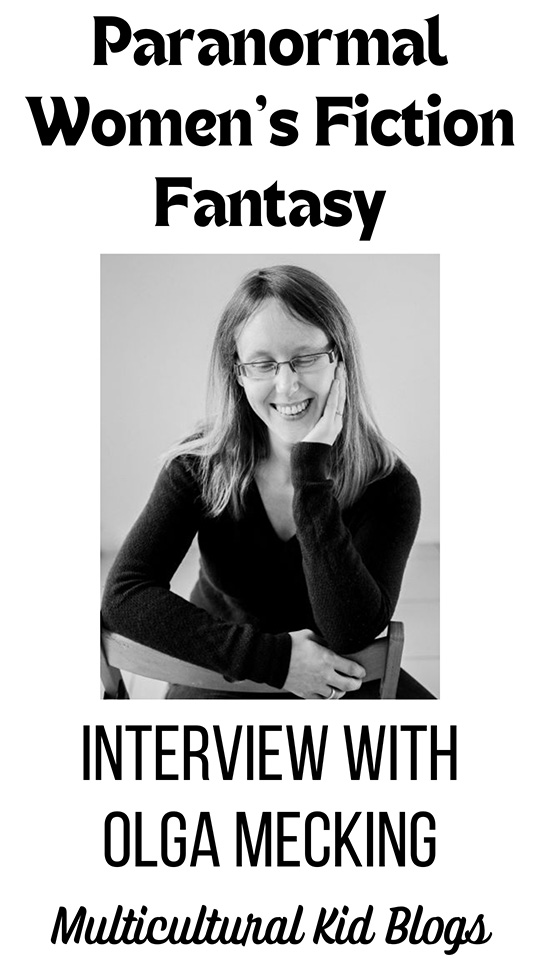
Our friend Olga Mecking, an early member and supporter of Multicultural Kid Blogs, started as a blogger before transitioning to become a writer. I chatted with her recently about her newest endeavor, a paranormal women’s fiction fantasy series, which my book club started reading earlier this year. I asked Olga about the series and the inspiration behind it, as well as how fantasy books can help us see our own world through a multicultural lens.
This post contains affiliate links. If you click through and make a purchase, Multicultural Kid Blogs receives a small commission at no extra charge to you.
Tell us about your series and the inspiration behind it.
The Nehalennia’s Daughters series had several sources of inspiration – from my own experiences of becoming a mother to my life as an immigrant in The Netherlands, and this is by design. Because I do not have much of a visual imagination, I had to use elements, settings and events that either happened to me, I read/heard about or somehow managed to logically deduce. For example, a big theme in the series is the fear of losing your child. This was inspired by something that happened many years ago but I sometimes think about, where a woman called the police on me because of my child’s temper tantrum. The swimming pool where Anneliese takes her swim lessons in the first book is the same one my kids use to take theirs, and so on. So it’s a fantasy book series based in mythology, but it is still very rooted in reality.
The genre of the series is described as paranormal women’s fiction fantasy. What exactly does that mean and what drew you to it?
So first, it is helpful to define what paranormal women’s fiction (or PWF), actually is. If you read a lot of fantasy, you’ll have noticed that in most books in that genre the protagonists, whether male or female, are either in their teens or somewhere in their twenties. Which, of course, makes a lot of sense, given that so many bullied/misunderstood teenagers dream of having some secret powers and being invited to attend a special magic school or something and finally being recognized for who they are. But where are the women in their 30’s and 40’s, saving the world while caring for teenaged children (and quite often their elderly parents), and maybe dealing with relationship problems all at the same time? And so several women writers got together and started their own genre, which they called PWF.
I decided to make my protagonists in their 30’s and 40’s simply because I am that age and it would allow me to showcase their relationships with their daughters at various stages of childhood. The youngest child in the series is 5 years old (Johanna), and the oldest is 12 (Hayley). Dutch women seem to have children later than in many other countries and that gave me a lot of space to explore these relationships.
I was also inspired by other books, movies and TV series that were in the same genre or tackled some of the same issues I did.
You are also known for your non-fiction works, including books like Niksen: Embracing the Dutch Art of Doing Nothing and your articles for publications like The Guardian. How was the writing process different (or similar) for writing paranormal fiction fantasy?
In non-fiction (whether it’s a straight newspiece, feature or personal essay), all the elements are already there (quotes, facts, sources). Your job as a writer is to put them together in a way that makes the most sense and will have the greatest impact on the reader, depending on topic, style, subgenre, etc. But in fiction, it’s all on you. You create everything from setting through characters and conflict to dialogue and theme. You are responsible for every single element in a fictional story. That can be both very freeing and very scary.
But I also found that fiction and non-fiction are actually not that different after all. For example, for my novel series I did tons of research (which included finding the years in which North Sea floods happened in the Netherlands, information about the goddess Nehalennia, farming practices of the future, spiritual practices and then some), just as I would for a non-fiction book. And some non-fiction genres, such as creative nonfiction (for example, memoir) uses fiction techniques such as writing in scene, having a character arc and following a plot. If you have ever read a good memoir – such as the one we just read for the book club, Why Didn’t You Tell Me? it felt a bit like reading a mystery novel, only it was all true. So the lines between these two genres are pretty blurred, and just because you are known for writing one kind does not mean you cannot write the other as well.
This is a five book series. To what extent did you have the whole series planned out before you started writing? Did the series evolve as you wrote?
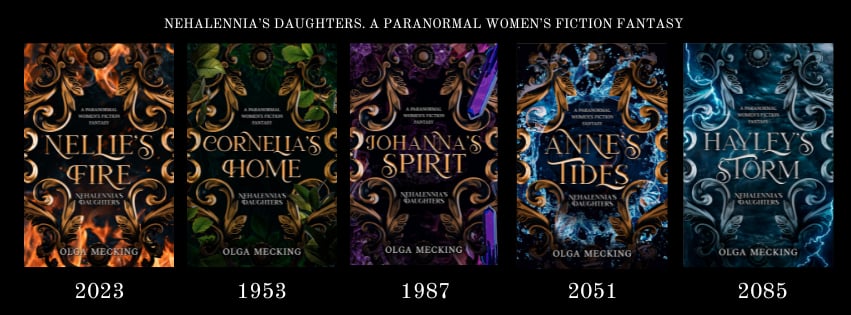
Yes and no. I first had the idea for a paranormal women’s fiction book, which later became Nellie’s Fire. But it quickly became clear to me that, since the book is about elemental powers, and there are five elements (I’m including the aether/spirit element here), there should be five books, although I did make things easier on myself by writing two of the five books as novellas rather than full-blown novels. I also knew that each book would take place in a different era (the timeline ranges from Cornelia’s Home, which takes place in the 1950’s, to Hayley’s Storm in the 2080’s), to make things more interesting for me. I have ADHD, and I knew I would not be able to follow the same protagonist through five books. At the same time, keeping the consistency between the books if they took place simultaneously, like, for example, Lucinda Riley’s The Seven Sisters series would be too hard, so I decided to space them around 30 years apart.
I did have a plan for each book, obviously. I actually wrote all the main scenes on flashcards, but it did not always go according to plan. For example, the character of Floris, the Dutch vampire, was supposed to be a one-time thing. He was only there to make Nellie’s life a bit more complicated when she went to see her mother in Zeeland. Many writers claim that characters start taking a life of their own, and I swear this is true. So I thought, what if he was a vampire? He became one of my favorite characters and an important part of the whole series. He even got his own character arc and resolution.
But I planned the books out one by one, rather than the whole series. What I did decide early, though, was which character would have which elemental power. Here it helped to make mothers and daughters very different from one another, also in terms of character. This (I hope) creates more tension and makes the books more interesting.
The witches are each associated with a different element, but they are all connected to the sea goddess. Why is she the link that connects them all?
I don’t even remember where I first learned about Nehalennia, but I was absolutely fascinated by this old, pre-Roman, mysterious goddess who seemed to have been worshipped in The Netherlands for such a long time. And while she is the villain of the first few books, the more I read about her, the more real and complicated she became in my mind. I was fascinated by myths and legends from all over the world and my home country, Poland, also has quite a few of them. For example, the Baltic Sea has its own goddess as well, called Jurate. It was cool to find out that the North Sea also has a goddess all of its own.
As for the five elements, I loved watching “Captain Planet” as a kid. The elements allowed me not only to figure out what kind of magic my characters would do, but I also let the character’s element define her looks and personality. (It is not a coincidence that Nellie is a fire witch who has red hair, amber-colored eyes and freckles as well as a very fiery personality). It also helped with the character descriptions because, as I mentioned, I do not see images in my head very much.
The paranormal women’s fiction fantasy series centers around the Netherlands. How did the setting affect the series?
Oooh, as you can imagine, quite a lot. First of all, I used The Netherlands as a setting because I have been living here and have quite a good grasp on Dutch customs, traditions and culture. But it also allowed me to do some really cool things, story-wise. For example, I could have Nellie, the outspoken protagonist of Book 1, smoke, and swear in diseases. As I have survived Dutch swim classes myself (no, I swear I did not make it up, they do swim in clothes and shoes), I knew I had to include this.
I even came up with a Dutch name for supernatural beings – De Ongewonen, or Unusuals – especially appropriate in a country that values normalcy over everything else. This also created a lot of conflict between my fiery character, Nellie, and a society that doesn’t really want her to stop existing but would rather prefer her to be more quiet, less fiery etc. Not to mention that having a protagonist who is afraid of water living in a country surrounded by it was pure storytelling gold!
And it almost felt like The Netherlands was a character all in itself. This changed a bit as the series moved into the future, but it is definitely a big influence on pretty much the whole series – from choice of characters to setting, to conflict.
Each main character goes on a personal journey as well as a process of growth in their supernatural powers. How are the two linked?
That is basic storytelling theory. Each character has to have an outer journey (fighting monsters, going on a quest, searching for a magic object), but there also has to be an inner journey of self-discovery and reckoning with one’s own weaknesses. If you look closely, each good story is actually two stories in one, and it is about how the character reacts to the events in the story and how they change in response to it. The outer layer makes the story interesting, and the inner one makes the reader care about the character. In my series, the witches mastering their powers are connected to them facing their biggest fears – this is by design, of course. Mastering their powers also meant mastering their own fears and weaknesses and coming out on the other side stronger and wiser (or not, lol, not trying to spoil anything here).
How does the treatment of supernatural people (“the Unusuals”) help us think about the treatment of the Other in our own societies?
I’m glad you picked up on that. Many different authors tackle the presence of supernatural beings in different ways (from hidden to open). But in my case, I knew Dutch society would not strictly forbid supernatural beings, but rather highly regulate them, as they do everything else. I am pretty sure vampires, if they existed, would be invited for regular feedings every month. (This idea was actually inspired by the way the Dutch rolled out the Covid vaccine – by birth year). I also make some parallels between the treatment of immigrants, drug users and supernaturals.
In the case of my protagonists, they are actually Dutch so they do not experience the full scope of discrimination as many people of color/immigrants do, but because they are so different (not only from humans but also other Unusuals), they are often ridiculed, ostracized or at least ignored and heavily policed.
But yes, supernatural beings, especially vampires and werewolves have always been used as some sort of blank screen to showcase our greatest fears onto.
Thank you to Olga Mecking for taking the time to answer my questions about her new paranormal women’s fiction fantasy series, Nehalannia’s Daughters! You can also watch our interview from 2023 about her book Niksen: Embracing the Dutch Art of Doing Nothing or connect with Olga by following her on Instagram.
Related Posts:
Science Fiction and Fantasy for Children
My Journey from a Blogger to a Writer


Leanna
Latest posts by Leanna (see all)
- Ayyam-i-Ha Around the World - February 23, 2026
- African American Women Leaders: New Picture Book Biographies - February 2, 2026
- Raising Hopeful Kids In Difficult Times - January 27, 2026
