I’m Heidi Rabinowitz, and I am so happy to be Jewish. The beautiful and varied customs, the focus on deep thought and learning, and the historical connections going back over the centuries, all bring me joy. That’s why I’ve dedicated my career to synagogue librarianship and why I’ve been podcasting about Jewish children’s literature for over a decade. In fact, the 20th anniversary of The Book of Life Podcast will take place in December 2025 – stay tuned, I’m making celebratory plans!

What?
I’m thrilled to share this Jewish Joy series for Multicultural Kid Blogs with you. I bring you Q&A’s from diverse intersectional Jewish authors, showcasing the variegated tapestry of Jewish life and books. I link to the author’s Book of Life Podcast episode so you can hear their voice and learn more.
Why?
In these turbulent times, with antisemitism at record highs, Jewish joy is crucial. As poet Toi Derricotte says, joy is an act of resistance. Joyful books invite everyone in, so that Jewish stories can, in the words of Dr. Rudine Sims Bishop, become windows as well as mirrors, bringing hope, demystifying the Jewish experience, and building empathy and understanding.
Who?
Last time you met Lesléa Newman, prolific author of books for every age who draws upon her Jewish and LGBTQ+ identity in her writing. Today, I’m thrilled to introduce you to a pair of Sephardic Jewish authors, Sarah Aroeste and Bridget Hodder. I interviewed them together at the Highlights Foundation, and they appeared on The Book of Life podcast in 2022.
Sephardic Jews are those whose families were expelled from Spain during the Inquisition over 500 years ago. Sarah and Bridget both proudly showcase their Sephardic Jewish heritage in their writing. Sarah is a singer and performer as well as an author, and taps her love of the Ladino language in her board books for babies. Bridget is a bridge builder, who has co-authored two books with Muslim writer Fawzia Gilani-Williams. If you’d like to hear more from Sarah and Bridget in their own voices, please click the podcast link below.
Q&A with Sarah Aroeste & Bridget Hodder
THE BOOK OF LIFE: Please describe your own Jewish identity, along with any other aspects of your identity that you’d like to share.
SARAH AROESTE: I grew up in an active, culturally Jewish family. My father (z’l) was a Jewish professional, directing several national Jewish organizations, so having a strong sense of Jewish peoplehood was instilled in me at birth. My mother’s family is where I get my proud Sephardic identity. My maternal grandfather was the oldest of nine brothers and sisters from what is today Bitola, N. Macedonia. When he was born there, it was part of the Ottoman Empire, which always sounded so exotic to me as a young girl. I loved that I was the only one in my elementary school classes who could point to that part of the world on a map! As I got older, however, it felt isolating that my Sephardic heritage was so under-represented. And our language of Ladino? None of my peers had ever even heard of it! That’s what pushed me eventually to pursue a career in Sephardic education.
BRIDGET HODDER: I’m Sephardic, an identity that sustains me and brings great joy. But long ago, well-meaning Ashkenazi friends told me that the traditions and ways of thinking I learned from my mother and grandmother were not Jewish, because they were completely different from their traditions, language and outlook. As a result, I felt alienation, confusion and even shame among Jewish peers.
I now realize my family’s differences are simply another, equally valid part of the varied and beautiful international customs, languages, foods and rites that make up the vivid tapestry of the Jewish peoples. Our differences are not things to be tolerated…they’re things to be celebrated! So I do celebrate them. And through my books, I invite others to do the same.
TBOL: Why is it important to you to include Jewish representation in your writing?
SA: I can’t think of one book I read as a child that had a meaningful Sephardic character or setting. As soon as I became pregnant with my first child 12 years ago, I knew that I wanted to create books that my daughter could see herself in. There are so many types and colors and backgrounds of Jews who don’t subscribe to what has become an “ashkenormative” way of seeing Judaism (in America, at least). I wanted to make sure that Sephardic symbols, words, and characters could become normalized during my children’s – any many other children’s – upbringing. We’re getting there!
BH: I think all kinds of Jewish rep should be included everywhere! So I’m thrilled to have the chance to share my own version of it with readers. My first Jewish-content book came from the place in my heart where my grandmother will always be. She’s truly the one who taught me what it meant to be proud of my Sephardic identity, by living it out loud. I want to write Sephardic characters in particular because our convivial and vibrant culture deserves to be enjoyed by as many readers as possible!
TBOL: About being Jewish: what is hard, and what brings you joy?
SA: Certainly, explaining Sephardic culture – and specifically what Ladino is – has always been a challenge. Getting recognized as equally Jewish and valuable by mainstream Jewish and literary worlds has been an uphill battle my whole career. But nothing beats getting a piece of fan mail from a parent saying thank you for writing my books and showing their family on the page. That joy makes it all worth it.
BH: There’s so much that’s hard these days. When you have unelected rulers in the US openly throwing N*zi salutes, it’s time to pause and ask yourself: am I doing everything I can to prevent “Never Again” from fully morphing into “Here We Go, Again”? As a Jew and the daughter of a Holocaust survivor, married to the son of a Holocaust survivor, I feel like I’m in a position to see the dangers of this national moment in the context of history. I’m working day and night to keep up with the constantly developing challenges not just for Jews, but for everyone who will be affected if things keep going in a terrible direction.
And uplifting joy in the midst of fear and uncertainty is crucial. One strange joy that’s arisen from recent national and international crises is that I’ve seen a lot of young people embracing their Judaism in ways they didn’t before. Including my own son, who lives in a state where there are almost no Jews but has found a tiny Reform congregation that has welcomed him. At first, I found this upswelling of enthusiasm surprising, as I would have thought increased antisemitism would encourage our young people to repudiate that part of their identities, rather than cultivate it.
But I underestimated them. I think the rising young Jewish generation, along with all the wonderful non-Jewish young people who are almost…but not quite…full adults, will actually be able to fix the mess that older, jaded, meaner generations have left for them. They are their own hope. And it gives me joy to continue to strive on their behalf. It confirms that our efforts in writing Jewish content of all kinds are worthwhile. As authors, we can take joy in supporting them.
May the work of their hands and hearts succeed.
TBOL: What do you want the world to know about Jewish people?
SA: I can sum it up by one of my favorite Ladino proverbs: Todos los dedos de la mano no son unos. All the fingers of the hand are not the same. Jews are such a mix of stories, geographies, colors, flavors. You need all of us to make up a hand though. It’s our uniqueness and differences that create the one hand of Jewish peoplehood.
BH: I want to remind folks that Jews have been in the USA since the 1600s. Not that it should matter, but we are not guests or newcomers; Jews were among those who founded and shaped this country. We understood what persecution and injustice looked like, which is why we played active roles in building the structural rights and protections we have today in the US. But those rights are now under attack, no matter who you are.
We practice Judaism not solely for our own community; we are told to keep our religious promises for the benefit of the entire world. Those we know, and those we will never know; those alive now, and those who are yet to come. That’s why we walk the walk against the violations of other groups’ rights, and we work to fill their needs as well as our own. This is who we are. So I hope others will find the strength and discernment to stand up for us, as well, when we need you.

TBOL: Please tell us about the Jewish books you’ve written.
SA: My first book, Buen Shabat, Shabbat Shalom, introduces families to the Sabbath by using Ladino words sprinkled throughout. “It’s Friday night, bueno, great! Let’s get ready to celebrate!” I use Ladino words in context and an easy refrain so that families can add simple phrases to their Shabbat repertoire.
The same goes for my second book, Mazal Bueno! While not overtly Sephardic in its prose, the book is meant to normalize Ladino phrases in the context of sharing a baby’s special milestones. When a child eats a first food, or takes a first step, many Jews around the world have other sayings of congratulations besides mazel tov. Mazal bueno is just as beloved and fun to say!
My next book is Uno, Dos, Tres: A Sephardic Counting Book, which has numbers up to 10 in Ladino matched with colorful Sephardic symbols like a hamsa, hand drums, fezes, keys and more. For young children it’s a fun way to teach numbers, and on another level, it’s an important way for young families to think about what “looks” Jewish.
This summer’s release is Anyada Buena, Shanah Tovah, which is a beautiful, quiet book that introduces the Sephardic new year greeting as well as the Sephardic seder. There have been recent picture books that highlight this special ritual, but I believe this is the first board book to do so.
Last up for the year is a nonsense book, Bavajadas: That’s Just Silly! I love this board book because, in the goal of creating Jewish joy, I wanted to write a book that was just upside down, wacky fun while also learning a very silly Ladino word – bavajadas. (Don’t worry, there’s a pronunciation guide in the book.) It’s so fun to say and I hope readers will smile and giggle the whole way through!
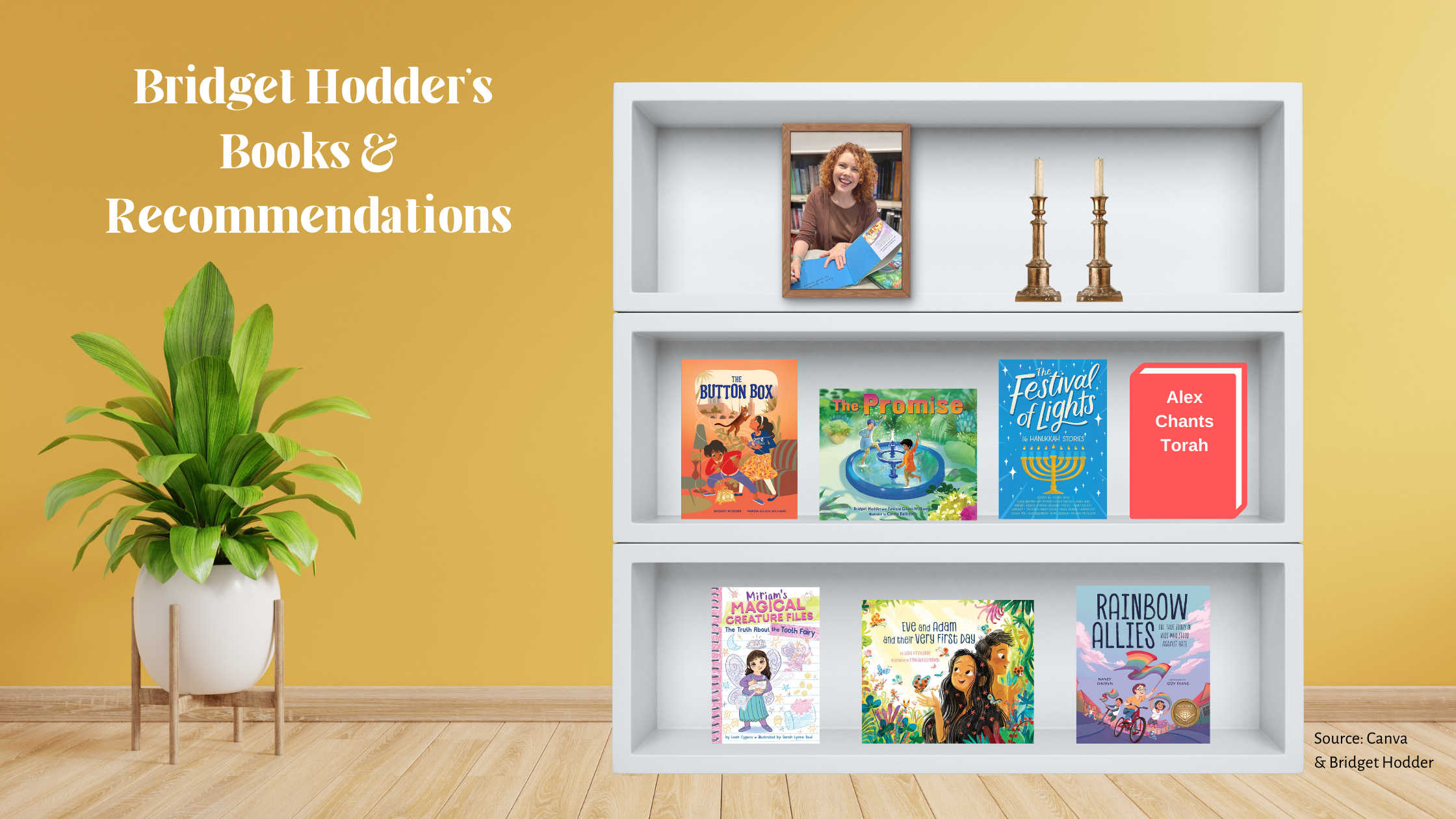
BH: I co-authored and absolutely loved writing the novel The Button Box and picture book The Promise with Fawzia Gilani. Right now, I’m most excited about the upcoming paperback version of The Festival of Lights: Sixteen Hanukkah Stories that will be out in time for Hanukkah this year! I’m also working on a beautiful real-life Jewish story, Alex Chants Torah, which features a boy with disabilities whose love for Torah would not be denied or stopped…and who is now a young man, just about to celebrate aliyah #90 with his entire shul!
TBOL: What other Jewish books are you excited about, and why?
SA: I’m so excited whenever a new Sephardic children’s book comes on the scene. I have a weekly book review series called the “Livros Lookout” (livros is the Ladino word for books), in which I highlight books with Sephardic themes. I’m thrilled every time I get to review Sephardic kidlit!
Recent titles that excite me are the middle grade novel, Across So Many Seas by Ruth Behar. I love how she weaves together such vivid Sephardic young women over many different centuries and settings. It’s just gorgeous. For kids who like graphic novels, José and the Pirate Captain Toledano by Arnon Z. Schorr and Joshua M. Edelglass is a great option. It’s a swashbuckling adventure with Ladino words to boot! There are several new books about one of my favorite Sephardic heroines, Doña Gracia Nasi, which I’m always happy to see. Yael Zoldan’s The Girl with the Secret Name and Bonnie Goldberg’s Doña Gracia Saved Worlds are two examples. For picture books, A Turkish Rosh Hashanah by Etan Basseri and illustrated by Zeynep Özatalay easily incorporates Ladino words into the narrative which I always love seeing. And of course, I was so excited that An Etrog from Across the Sea by Deborah Bodin Cohen and Kerry Olitzky and illustrated by Stacey Dressen McQueen won the Sydney Taylor Book Award! A story about an 18th century Colonial American Sephardic family? Yes, please!!
BH: I’m eagerly anticipating my friend Leah Cypess’s Jewish early chapter book series, Miriam’s Magical Creature Files published by Amulet Books. The first in the series deals with Miriam sussing out the truth about the Tooth Fairy, and I just can’t wait!
Leslie Kimmelman’s Eve and Adam and Their Very First Day–a tender and lovely midrash in picture book form–has been the subject of some ignorant hate-bombing lately, so I’m making sure to spread the word that it’s a true gem of a book. What a sweet and refreshing new perspective on the story!
And finally I just have to mention my friend Nancy Churnin’s wonderful Rainbow Allies: The True Story of Kids Who Stood against Hate. This picture book about neighborly love in defense of a same-sex married couple strikes a perfect note of hope and strength in these challenging times. It demonstrates how doing right can bring joy to all involved. And it’s written by a winner of the National Jewish Book Award! What’s not to like?
TBOL: Sarah and Bridget, thank you so much for sharing your Sephardic heritage with the world in such a joyful way.
SA & BH: Thank you so so much for all the good you do our community and for kids in general, Heidi!

Discover more interviews in the Jewish Joy Series!
Ruth Behar – a Latina Jewish author of middle-grade fiction and picture books and a cultural anthropologist
Richard Ho – a Chinese Jewish picture book author
Emily Bowen Cohen – a Muscogee Jewish author of a middle-grade graphic novel
Veera Hiranandani – an Indian Jewish author of middle-grade and picture books
Andrew Sass – an author who writes middle-grade fiction on Jewish identity, neurodiversity, and gender
Shoshana Nambi – a Ugandan Jewish picture book author from the Abayudaya community
Emi Watanabe Cohen – a Jewish Japanese fantasy author
Lesléa Newman – an author who draws upon her Jewish and LGBTQ+ identity in her writing
Sarah Sassoon – a Mizrahi Jewish author of picture books showcasing her Iraqi heritage


Heidi Rabinowitz
Latest posts by Heidi Rabinowitz (see all)
- Jewish Joy with Deke Moulton - October 19, 2026
- Jewish Joy with Richard Michelson - September 22, 2026
- Jewish Joy with Rachelle Burk - August 24, 2026
