
I’m Heidi Rabinowitz and I am so happy to be Jewish. The beautiful and varied customs, the focus on deep thought and learning, and the historical connections going back over the centuries, all bring me joy. That’s why I’ve dedicated my career to synagogue librarianship and why I’ve been podcasting about Jewish children’s literature for over a decade. In fact, the 20th anniversary of The Book of Life Podcast will take place in December 2025 – stay tuned, I’m making celebratory plans!
What?
I’m thrilled to share this Jewish Joy series for Multicultural Kid Blogs with you. I’ll be bringing you Q&A’s from diverse intersectional Jewish authors, showcasing the variegated tapestry of Jewish life and books. In each interview, I’ll link back to the author’s appearance on The Book of Life Podcast for you to hear their voice and learn more about them.
Why?
In these turbulent times with antisemitism at record highs, Jewish Joy is crucial. As poet Toi Derricotte says, joy is an act of resistance. Joyful books invite everyone in, so that Jewish stories can, in the words of Dr. Rudine Sims Bishop, become windows as well as mirrors, bringing hope, demystifying the Jewish experience, and building empathy and understanding.
Who?
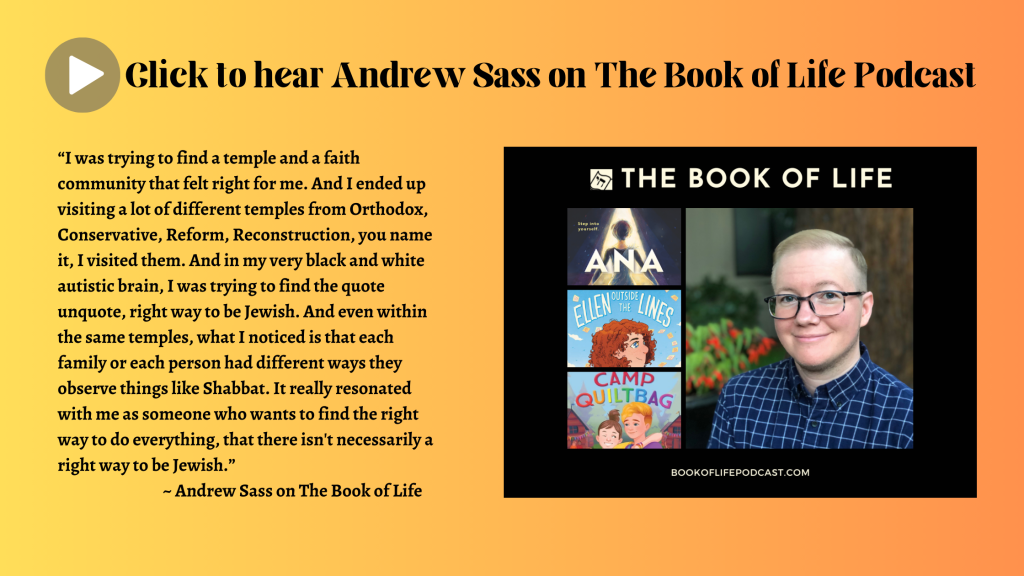
In the last Jewish Joy post in this series, you met Veera Hiranandani, an Indian Jewish author of middle grade and picture books. Today, I’m thrilled to introduce you to Andrew Sass (he/they) a figure skater and author who writes middle grade fiction on Jewish identity, neurodiversity, and gender, and who is entering the picture book genre soon. Andrew appeared on The Book of Life podcast in 2023 to talk about Ana on the Edge, Ellen Outside the Lines, and Camp QUILTBAG.
Andrew’s writing is very intersectional. He himself is a gay, transmasculine, non-binary, autistic Jew by choice, and those many identities are reflected in his writing. He portrays the emotional journeys of characters who are grappling with their gender identities, exploring their Jewish heritage, and learning to navigate the world in their own ways. I’m pleased to bring you this exclusive interview for Multicultural Kid Blogs, and if you’d like to hear more from Andrew in his own voice, please click on the podcast link below.
Q&A with Andrew Sass
THE BOOK OF LIFE: Andrew, please describe your own Jewish identity, along with any other aspects of your identity that you’d like to share.
ANDREW SASS: Judaism feels like it has been an important part of my life since I first learned about it all the way back in elementary school. I often describe what felt like a near-instant connection as ‘inexplicable,’ because I wasn’t born or raised Jewish; I didn’t even grow up in many places that had Jewish communities. I spent my childhood primarily in the Upper Midwest and South, yet books offered me a window to learn through the eyes of various Jewish characters. This connection continued to grow once I read non-fiction resources that I checked out of the library to learn more about Jewish history and beliefs.
During college, I majored in Jewish Studies and minored in Hebrew, then ultimately went on to convert and become a recognized member of the community. Judaism’s encouragement of questioning resonates with me as someone who is also queer and autistic. It has allowed me to dig deeper in my journey to understanding so many aspects of myself. It feels like I’m learning something new about myself and Judaism almost daily. I’m so grateful I get to be a part of the Jewish community.
TBOL: Why is it important to you to include Jewish representation in your writing?
Andrew Sass: When I was growing up, the only stories I could find about Jews (both fiction and nonfiction) tended to be Holocaust literature. The Holocaust is an important topic to educate yourself about, without question, but it left me longing to read stories about Jewish characters in contemporary settings. How might a contemporary Jewish character’s experiences in school, daily life, etc. be similar or different from their non-Jewish peers? And how might the lens through which they see the world be impacted by intersecting LGBTQIA+, neurodivergent, and other identities? As an author of contemporary children’s stories, it felt natural to explore these questions in the books I write. It also feels important to highlight how wonderfully diverse the Jewish community is—and how it’s a community still thriving and making a positive impact on the world today, despite so many past and ongoing hardships.
TBOL: About being Jewish: what is hard, and what brings you joy?
Andrew Sass: It can be hard not to be understood (or to even be misunderstood) by non-Jewish friends, colleagues, and communities—even ones of which I am a member: book events scheduled on Shabbat, a deadline that runs up against a holiday I observe, and having to explain why my temple requires around-the-clock security when that’s not the case for other nearby buildings that house religious communities, among so many other things.
But any frustration I experience in that sense is largely offset by how much joy and affirmation I feel in getting to be part of my local Jewish community and the Jewish people as a whole. We might not always agree on everything, but the support and love are always there, because at the end of the day, we are family.
TBOL: What do you want the world to know about Jewish people?
Andrew Sass: As an ethnoreligion that has so many thriving communities both within and outside of Israel, there is no one correct way to look, practice, or be Jewish. It can be easy to make assumptions about any group of people you don’t know well or haven’t encountered often in your life, but there are so many ways to familiarize yourself with Jewish people and their beliefs nowadays, even if you don’t live near a local community: read a book that centers a Jewish character (if you like children’s and YA lit, a great place to find recommendations is the annual list of Sydney Taylor Award and Honor books); watch a Jewish content creator who shares what their life is like on social media (Miriam Ezagui is one of my favorite Orthodox Ashkenazi TikTokers); or find reputable resources online to answer specific questions you may have (My Jewish Learning is a favorite starting point of mine that I often find leads me to seek out additional, more in-depth resources on topics of interest).
TBOL: Please tell us about any Jewish books you’ve written.
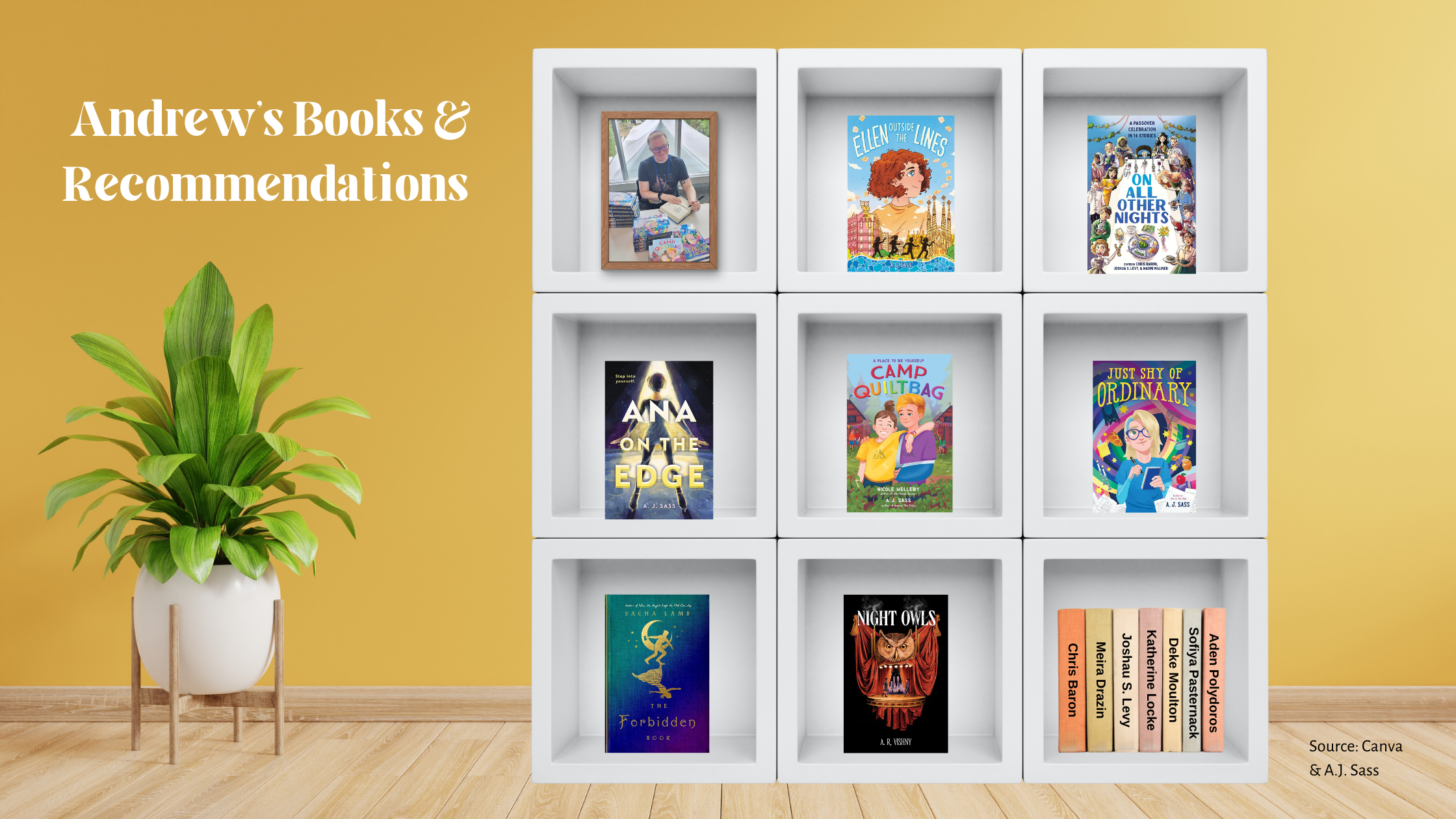
Andrew Sass: Ana on the Edge: The main character, Ana, is a biracial Jewish competitive ice skater who is exploring her newly discovered nonbinary gender identity. While Judaism is a small element of this story of self-discovery, Ana finds herself asking questions such as, ‘what do I call my upcoming mitzvah ceremony if I’m not a boy (bar) or a girl (bat)?’ Ana’s mom is a convert to Judaism, and Ana’s best friend, Tamar, and her family attend the same temple as Ana and her mom.
Ellen Outside the Lines: Ellen is an autistic, queer, and Jewish thirteen-year-old whose dad grew up in a Haredi community in Israel and whose mom is a cantor at their Georgia synagogue. Judaism is a big part of Ellen’s life, from keeping kosher to observing Shabbat every week. But as Ellen learns while on a class trip to Barcelona, Spain where her chaperoning abba isn’t keeping as stringently kosher as he does back home, everyone’s relationship to Judaism is a little different, and embracing these differences can be wonderful and affirming.
Camp QUILTBAG: I co-wrote this story about inclusivity and queer community with Nicole Melleby. It was such a joy to write. Set at a summer camp for queer and trans youth, Nicole and I got the opportunity to feature so many different LGBTQIA+ identities and experiences. It also gave me the chance to explore different types of Jewish observance when one of our main characters, Kai, meets another camper, Oren. Kai’s family is interfaith (Reform and Lutheran) while Oren’s family is coded more along the lines of Orthodox or Conservative (his family switched synagogues after he came out as gay). While the story isn’t focused on Jewish identity, Kai’s interest in how Oren practices opens the door for reader discussions about the different ways someone can embrace their Jewish identity.
Just Shy of Ordinary: This book is, in part, my exploration of what makes someone Jewish. Under halakha, main character Shai would be considered Jewish because their mom, grandmother, etc. are Jewish. But Shai’s mom didn’t raise them Jewish, so when Shai develops an interest in their Jewish heritage, it sparks many questions. This leads Shai to start attending their grandparents’ temple as they strive to learn how Judaism approaches nonbinary identities, and so much more.
I also contributed a short story to On All Other Nights: A Passover Celebration in 14 Stories, edited by Chris Baron, Joshua S. Levy, and Naomi Milliner, called The Awful Omen, which follows Sammy as they struggle with anxiety while trying to find a way to come out to their family as nonbinary when everyone gets together for the Passover Seder.
Then next year, I have my debut picture book releasing. The book is illustrated by Noa Kelner and called Shabbat Is … It follows three kids who attend the same temple who all observe Shabbat with their families in different ways. Because, as you might’ve already guessed from my other answers, I fully embrace the belief that there is no one right way to be Jewish.
TBOL: What other Jewish books are you excited about, and why?
AS: So many!
- Night Owls by A. R. Vishny (9/17/24)
- The Forbidden Book by Sacha Lamb (10/1/24)
- A Flame Burns On by Richard Ho (Summer 2026)
- Plus anything written in the future by: Chris Baron, Meira Drazin, Joshua S. Levy, Katherine Locke, Deke Moulton, Sofiya Pasternack, and Aden Polydoros.
- I’m also keeping my fingers crossed that Kasey LeBlanc writes a Jewish book at some point down the road (his exploration of the challenges of coming out trans as a Catholic school student in his debut, Flyboy, was fantastic).
I’m excited about these authors and their future projects because each story promises to approach Judaism from diverse and intersectional angles. Stories like these are so important. I can’t wait to add these books to my bookshelf, and I also can’t wait to see what some of the authors I listed who haven’t publicly shared news of their future books yet will be publishing in the years to come.
TBOL: Andrew, thank you so much for sharing your personal story with us, as well as so many amazing reading recommendations!
AS: My pleasure! I wanted to tell you one more thing, about a photo of myself I’ve shared here. I tend to find staring directly at people or cameras uncomfortable so my vision of joy might look different from other people’s, but this image was taken at the Columbus Book Festival, where I was absolutely thrilled to get to sign books and meet readers. I hope it conveys joy to others as much as I felt it on that day.
TBOL: I love that you are showing us another way to be joyful. Thanks again, Andrew!


Heidi Rabinowitz
Latest posts by Heidi Rabinowitz (see all)
- Jewish Joy with Deke Moulton - October 19, 2026
- Jewish Joy with Richard Michelson - September 22, 2026
- Jewish Joy with Rachelle Burk - August 24, 2026
