I’m Heidi Rabinowitz and I am so happy to be Jewish. The beautiful and varied customs, the focus on deep thought and learning, and the historical connections going back over the centuries, all bring me joy. That’s why I’ve dedicated my career to synagogue librarianship and why I’ve been podcasting about Jewish children’s literature for 20 years on The Book of Life, and established a new hub for Jewish kidlit at The Jewish Book Garden on Substack. That is also why I created the Jewish Joy series here at Multicultural Kid Blogs!
What?
I’m thrilled to share this Jewish Joy series for Multicultural Kid Blogs with you. I’ll be bringing you Q&A’s from diverse intersectional Jewish authors, showcasing the variegated tapestry of Jewish life and books. In each interview, I’ll link back to the author’s appearance on The Book of Life Podcast for you to hear their voice and learn more about them.
Why?
In these turbulent times with antisemitism at record highs, Jewish Joy is crucial. As poet Toi Derricotte says, joy is an act of resistance. Joyful books invite everyone in, so that Jewish stories can, in the words of Dr. Rudine Sims Bishop, become windows as well as mirrors, bringing hope, demystifying the Jewish experience, and building empathy and understanding.
Who?
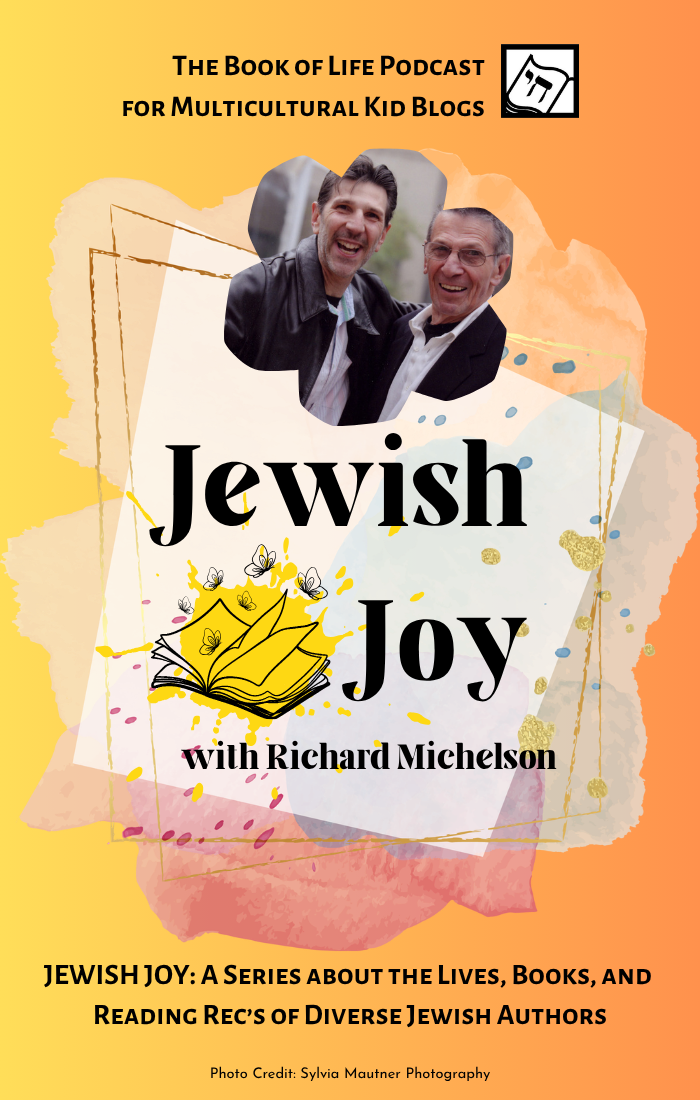
In the last Jewish Joy post in this series, you met Rachelle Burk, who writes true Jewish adventure stories. Today, I’m thrilled to introduce you to the multi-talented Richard Michelson, author of picture books and poetry. I’ve interviewed Rich many times on The Book of Life Podcast: in 2007 about Across the Alley, in 2009 about As Good As Anybody, in 2016 about Fascinating: The Life of Leonard Nimoy (see the photo above of Rich and Leonard together), in 2017 about The Language of Angels, in 2025 about One of a Kind: The Life of Sydney Taylor and again in 2025 about More Than Enough. The Book of Life also featured a print interview in 2025 with Eric Lesser, the subject of Rich’s biography Next Year in the White House.
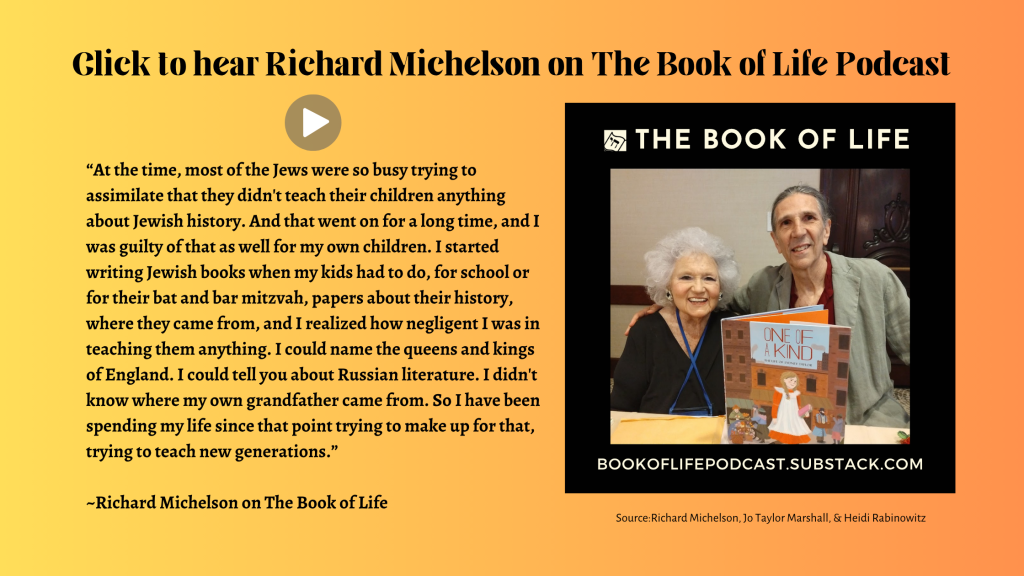
Rich is the winner of multiple awards, and owner of the R. Michelson art gallery of illustration. His writing digs deep into Jewish life in both biography and fiction. I’m pleased to bring you this exclusive Jewish Joy interview for Multicultural Kid Blogs, and if you’d like to hear more from Rich in his own voice, please click on the featured podcast link below, or any of the links I’ve listed above.
Q&A with Richard Michelson
THE BOOK OF LIFE: Richard, please describe your own Jewish identity, along with any other aspects of your identity that you’d like to share.
RICHARD MICHELSON: I grew up with no “Jewish education” of any kind. I did not have a Bar Mitzvah, and I never attended Hebrew School, or Jewish camps. My mother refused to step into a synagogue. If I may quote her in my poem “Unveiling”:
No soul but soil my mother taught /and it stuck; afterlife of neither God nor prayer, but pebble/mud-dirt.
But many decades ago, I married a religious Methodist who, when she was pregnant with our first child informed me, she had decided to convert to Judaism.
Jennifer studied in a class of two, the other being Julius Lester who I only knew as a SNCC activist who wrote Watch out Whitey—Black Power Gonna Get your Mama, and who had been publicly accused of antisemitism for allowing “Jewish hatred” to be spread on his popular NYC radio show.
That is who I saw davening in the front row with a tallis over his head the first time I accompanied my wife into a synagogue. That is who became my dear friend and
provided my initial education into Judaism.
The second half of my Jewish education was conducted by Leonard Nimoy [the actor who played Mr. Spock on Star Trek], who grew up in an Orthodox Yiddish speaking household. He recorded the audio for my kids’ book Too Young for Yiddish and we became fast friends.
A few years later Sleeping Bear Press asked me to write A is for Abraham: A Jewish Family Alphabet to teach the next generation of Jewish children about their heritage.
(My task was to boil down all of 5000 years of Jewish knowledge into 26 bite size Jewish poems for children. What could go wrong?)
Leonard [Nimoy] and I were having dinner, and I told him I’d turned down the offer. What did I know about Jewish customs and history. He said, “Rich, you are the perfect person to write the book because you can’t ask a fish to describe the water. You have to be standing on dry ground. You will have the exact same questions a child might.” I got up from the table and called back my agent. Leonard and I began to study together.
TBOL: Why is it important to you to include Jewish representation in your writing?
RM: Because I missed so much about the beauty of Judaism as a child, and I do not want other children to be as ignorant as I was. And I am also speaking to adults who grew up, like I did, without the history, and beauty of Judaism. Elie Wiesel once told me—”you have inherited its burden without its mystery,” which I used as an epigraph in my poem “The Jews That We Are.”
My pet peeve is when Jews are not included in various multicultural conversations. I often see grant applications for minority groups that exclude Jews, and multicultural
book lists without a single Jewish title, yet we are a smaller percentage of the population than other cultures included on those lists (Thank you Heidi and Multicultural Kids Blogs for broadening the perspective and educating those who post about, and host Multicultural sites).
TBOL: About being Jewish: what is hard, and what brings you joy?
RM: These days it is difficult to always have to educate those non-Jews around me on what is and isn’t antisemitic speech and behavior (and who gets to decide), specially in the left- wing circles that I inhabit. As for joy, I love the third Friday night of every month musical Shabbat services at my Jewish Community of Amherst, and the MVHC
summer Shabbat services on the beach on Martha’s Vineyard, and the January/February Shabbat on the beach in Nosara, Costa Rica. And the dinners afterward with friends.
TBOL: What do you want the world to know about Jewish people?
RM: That we are people, each as individual as those in any other group. That we come in all colors and nationalities, though we share a culture and a history.
TBOL: Tell us about any Jewish books you’ve written.
RM: All my books are Jewish books, because I wrote them. But assuming you mean books with a particularly Jewish theme:
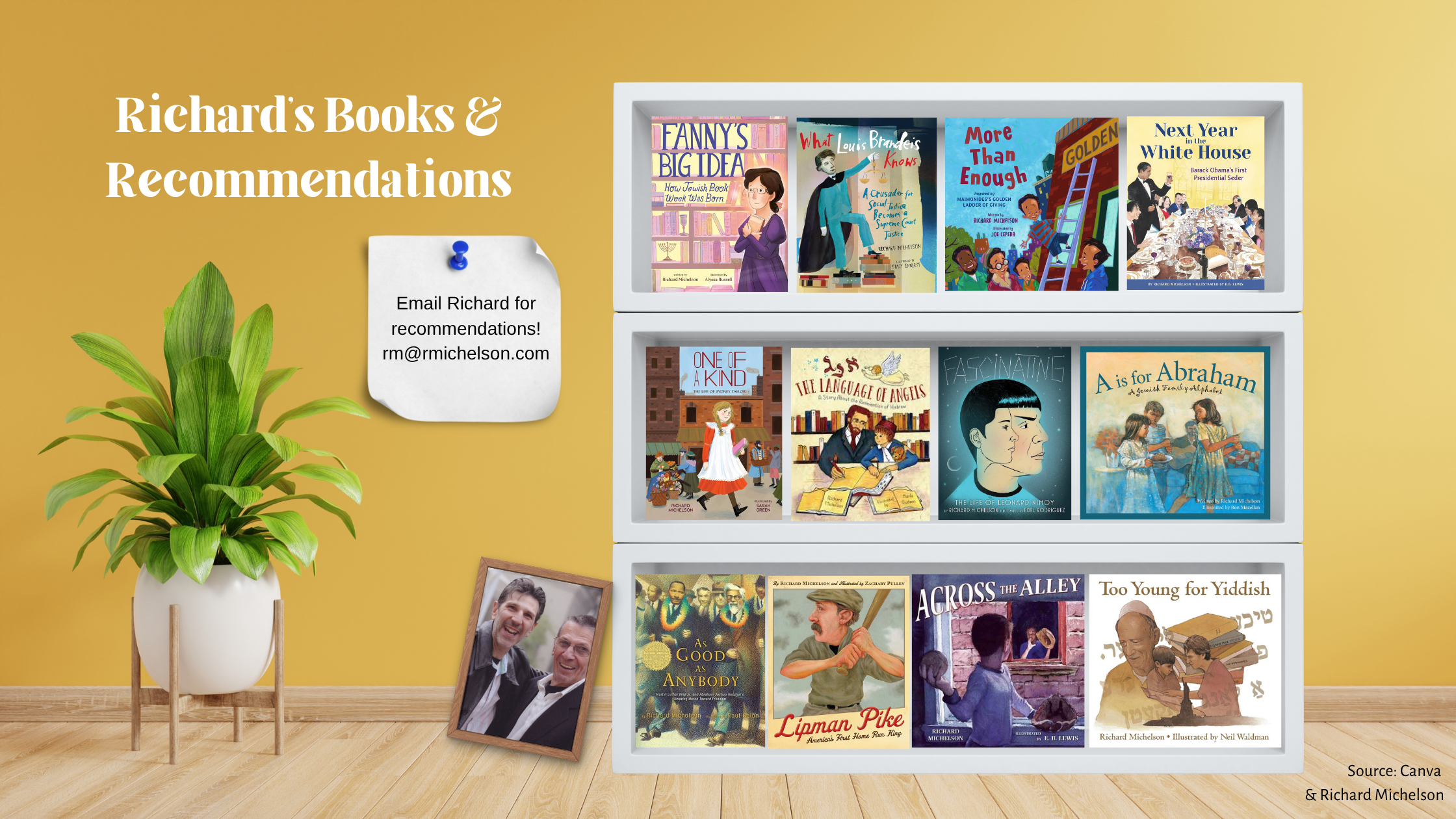
Books Fanny’s Big Idea: How Jewish Book Week Was Born was a 2025 National Jewish Book Award Finalist and an Association of Jewish Libraries Notable Book. It is a
celebration of the 100th anniversary of Jewish Book Week, and an introduction to the first librarian that started carrying books by all nationalities in her library.
What Louis Brandeis Knows: A Crusader for Social Justice Becomes a Supreme Court Justice tells how the lawyer/activist turned Supreme Court Justice drew on common sense and Jewish values to make a difference.
More Than Enough: Inspired by Maimonides’s Golden Ladder of Giving shows how a Jewish approach to charity can help to create a fair society.
Next Year in the White House: Barack Obama’s First Presidential Seder is the true story of how a small Seder dinner on the campaign trail inspired Barack Obama to bring
the tradition into the White House and host the first ever Presidential Passover celebration.
One of a Kind: The Life of Sydney Taylor is the true story of how Sarah Brenner, a poor girl from New York City’s Lower East Side, became Sydney Taylor: dancer, actress,
and successful children’s book author of the “All Of A Kind Family” series.
The Language of Angels: A Story About the Reinvention of Hebrew received a Sydney Taylor Gold Medal from the Association of Jewish Libraries and the 2017 National Jewish Book Award. It tells the story of the re-emergence of Hebrew as a modern, spoken, living language after 2000 years.
Fascinating: The Life of Leonard Nimoy is a biography of Leonard Nimoy that explains how his Jewish education informed his portrayal of Mr. Spock on Star Trek.
Lipman Pike: America’s First Home Run King is a biography of the first “professional” baseball player, who was left out of the history books because, as a Jewish man, he
didn’t fit the profile of an “all-American” hero.
A is for Abraham: A Jewish Family Alphabet is a joyful celebration of family and heritage.
As Good As Anybody: Martin Luther King and Abraham Joshua Heschel’s Amazing March Toward Freedom received the 2009 Sidney Taylor Gold Medal from the Association of Jewish Librarians and was a National Jewish Book Award Finalist. It explores the friendship of Reverend King and Rabbi Heschel and how together they marched for equal rights for all.
Across The Alley is a book about friendship. Jewish Abe and African-American Willie are best friends, but only secretly at night, through the windows of their city apartment buildings. Their bond strengthens when they discover that racism affected both their ancestors.
Too Young For Yiddish is a book about a boy who wants to learn about his immigrant grandfather’s language and history, while the grandfather wants the boy to leave the past behind and become “more American.”
My adult poetry books Sleeping as Fast as I Can, More Money Than God, and Battles & Lullabies also concern Jewish life and ideas. As the Jerusalem Post has kindly noted: “Richard Michelson has a profound grasp of Jewish history, of antisemitism and pogroms, of moral teachings and midrash, of sinner and prophets. ..[Michelson] is
an indispensable Jewish voice in this generation.”
TBOL: What other Jewish books are you excited about, and why?
RM: Oh my gosh. This has a golden age for Jewish poets and storytellers. My dear friend Jane Yolen recently passed so I will be rereading many of her books. And everything by my almost sister, Lesléa Newman. I was recently at the Association of Jewish Libraries conference in Chicago, and I wrote down 25 recommended titles, and before that at the Yetzirah National Conference of Jewish Poets – I have an even longer list. My poetry publisher, Slant Books, has a wonderful roster of Jewish (and non-Jewish) writers. I should only live so long to read just last year’s pile. Anyone can email me and I will hook you up with a great book. But don’t make me name names here, or I will leave out someone I shouldn’t, and Jewish guilt will kick in. Of those no longer with us, I am currently reading Chaim Grade’s Sons and Daughters, and I always have a Yehuda Amichai book in my glove compartment should I encounter a traffic jam.
TBOL: Rich, thank you for sharing your personal history and for filling our bookshelves with Jewish joy!


Heidi Rabinowitz
Latest posts by Heidi Rabinowitz (see all)
- Jewish Joy with Richard Michelson - September 22, 2026
- Jewish Joy with Rachelle Burk - August 24, 2026
- Jewish Joy with Adam Gidwitz - July 13, 2026
