I’m Heidi Rabinowitz and I am so happy to be Jewish. The beautiful and varied customs, the focus on deep thought and learning, and the historical connections going back over the centuries, all bring me joy. That’s why I’ve dedicated my career to synagogue librarianship and why I’ve been podcasting about Jewish children’s literature for 20 years on The Book of Life, and established a new hub for Jewish kidlit this year at The Jewish Book Garden on Substack. That is also why I created the Jewish Joy series here at Multicultural Kid Blogs!
What?
I’m thrilled to share this Jewish Joy series for Multicultural Kid Blogs with you. I’ll be bringing you Q&A’s from diverse intersectional Jewish authors, showcasing the variegated tapestry of Jewish life and books. In each interview, I’ll link back to the author’s appearance on The Book of Life Podcast for you to hear their voice and learn more about them.
Why?
In these turbulent times with antisemitism at record highs, Jewish Joy is crucial. As poet Toi Derricotte says, joy is an act of resistance. Joyful books invite everyone in, so that Jewish stories can, in the words of Dr. Rudine Sims Bishop, become windows as well as mirrors, bringing hope, demystifying the Jewish experience, and building empathy and understanding.
Who?
In the last Jewish Joy post in this series, you met A.R. Vishny, an award-winning debut author of Jewish paranormal romance. Today, I’m thrilled to introduce you to Adam Gidwitz, an award-winning middle grade author, storyteller, and podcaster. I’ve interviewed Adam several times on The Book of Life Podcast: in 2017 about The Inquisitor’s Tale, in 2019 in an episode about Jewish writing beyond the Holocaust and holidays, in 2024 about Max in the House of Spies, and in 2025 about its sequel, Max in the Land of Lies.
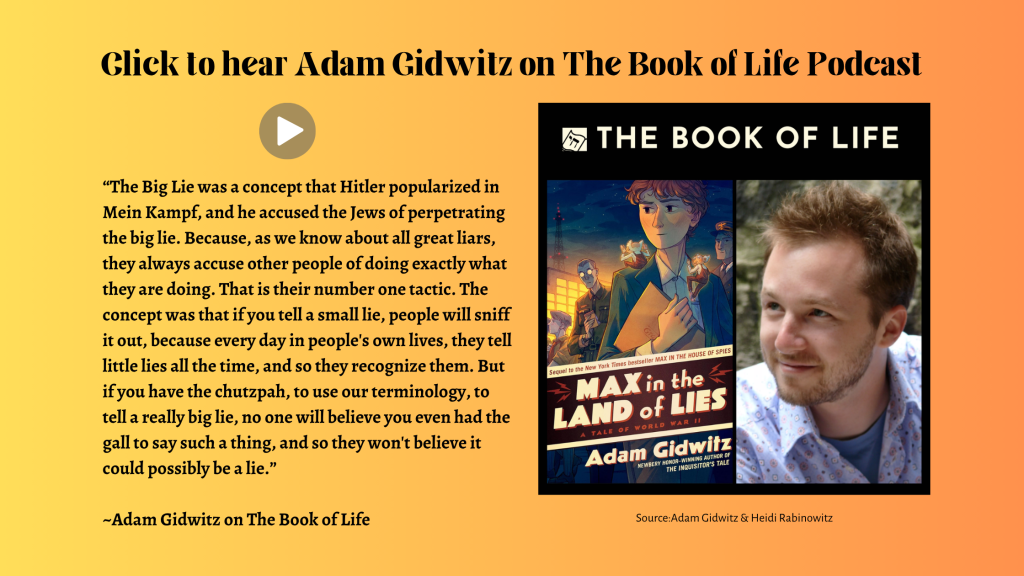
Adam is thoughtful and well-spoken, and his writing combines deep philosophy with quirky humor and a touch of magic. I’m pleased to bring you this exclusive Jewish Joy interview for Multicultural Kid Blogs, and if you’d like to hear more from Adam in his own voice, please click on the podcast link below.
Q&A with Adam Gidwitz
THE BOOK OF LIFE: Adam, please describe your own Jewish identity, along with any other aspects of your identity that you’d like to share.
ADAM GIDWITZ: I was raised Reform, which, for those not initiated, means we went to Temple on the High Holidays (Rosh Hashanah and Yom Kippur) and also had a Christmas tree. I found my early Jewish education rote and meaningless, and as soon as I’d had my Bar Mitzvah I asked my father if I could stop going to Hebrew school. He offered a deal: I could stop going if every Sunday morning, instead of Hebrew school, he and I sat together and read the Bible. We did that for a couple of years, and it was by far the most meaningful religious experience I had had to that point. We debated the meaning of the stories: Why did they say the Biblical characters lived for hundreds of years? Why did God command Saul to slay not only all the Amalekites, but also all their sheep and goats? Was King David a hero or not? This is when I learned the ethical and spiritual value of Judaism, and it is the kind of Judaism I practice now. The goal of my practice — Shabbat, Hebrew school for my daughter (a better one!), observing the holidays — is to be wiser, more grounded, more centered, and more connected to my family, the world, and the Divine.
TBOL: Why is it important to you to include Jewish representation in your writing?
AG: I wouldn’t say it’s important–I would say I want to. There is something so special about representing how you felt growing up in your writing — no matter what background you come from. The Own Voices movement that blossomed around 2020 was permission for all of us to write about what we knew best. (I think there might have been some excesses: it’s also important that we write about other kinds of folks — I can’t write books entirely populated by Jewish boys like me.) But it was an invitation to get away from thinking “What should a children’s book sound like?” and pivot to “What would a book about me be like?” To be clear, I place those representations of myself in different time periods and different bodies. But the combination of feelings I had growing up Jewish — pride, fear, joy, confusion, love — can be the inner lives of my characters. And that is inspiring and liberating.
TBOL: About being Jewish: what is hard, and what brings you joy?
AG: What’s hard about being Jewish? You don’t need the litany. If I had to choose one thing, it’s that people assume they know how you think, or what you should think. Since October 7th, the pressure I have felt from everyone, on all sides, to feel a certain way, to say certain things, to support certain people and hate other people… it’s not just exhausting, it has felt deeply wrong. The world is a complex place, and anyone who has a black and white view of it is, by definition, wrong. Amongst all the screaming at one another and the silencing one another, as a Jew I feel like I am standing in the center of the maelstrom, being pushed this way and that way depending on who is screaming the loudest or silencing the most cruelly.
What brings me joy is when I can step outside the maelstrom and sit down with a friend, Jewish or otherwise, and connect. After a conference recently, a Palestinian author and I grabbed each other and ran to get a coffee, and just emotionally let loose about the pressure we felt from our own communities and from “the other side” (as if such a thing existed). After a visit to a school, when, as often happens, a kid walks up to me and whispers, “I’m Jewish, too.” Or, if they’re playing it cool, “How was your Seder?” And then I give them a fist bump and smile, and they walk away beaming. When an Orthodox Jewish friend of mine and I sit down and do what my father and I did for years: debate a story from the Torah, and how it applies to today. That, to me, is Jewish joy. Lovingly, honestly connecting.
TBOL: What do you want the world to know about Jewish people?
AG: That the Golden Rule comes from Jewish teaching: “What is hateful to you, do not do to others. That is the whole of Torah. The rest is commentary.” And the second part of that maxim, too: “Now go, and learn.” The tradition of Judaism is so beautiful, so wise, so rich with ethics. People don’t see that enough. That is on them, and it is on us. We must live this central maxim. And we must show that we do. And when we show that we do, people must open their eyes and the see the truth.
TBOL: Tell us about any Jewish books you’ve written.
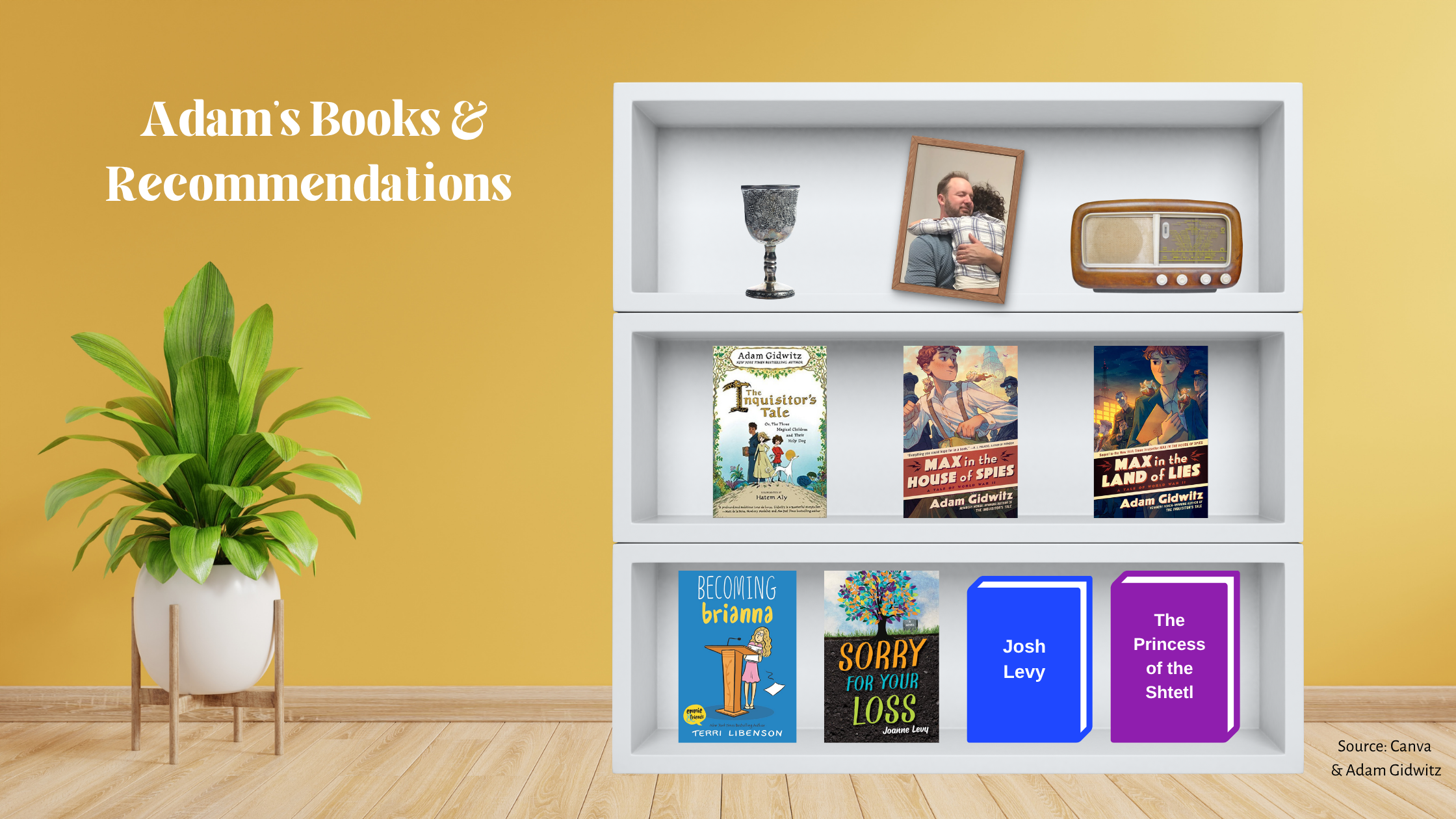
AG: Oy, where to start? Just kidding — I have three explicitly Jewish books: The Inquisitor’s Tale and the two Max books. The Inquisitor’s Tale is a medieval epic about three kids with apparently magical powers — and their holy dog, who died and came back to life. One child is a Christian peasant girl, another is a Christian monk whose mother is an African Muslim, and the third is a Jewish boy. Their goal is, first, to escape the king’s bigoted, violent knights, and then to save thousands of Talmuds from being burned. It’s a book about how people who are taught to hate and fear one another can coexist, how they (we) can connect. The central idea of the book is taken from the WH Auden poem: “You shall love your crooked neighbor with your crooked heart.” To me, that is the central commandment.
Max in the House of Spies and Max in the Land of Lies is a spy duology inspired by the experience of a close friend of my family’s, Michael Steinberg, who was one of the Jewish children taken from Nazi Germany to England in 1938 on the Kindertransport. At its heart, the Max books are about how a nation could become committed to lies, and destroy itself through its devotion to those lies.
TBOL: What other Jewish books are you excited about, and why?
AG: There are so many. My daughter is obsessed with Becoming Brianna, by Terri Libenson. It’s a wonderful combination of graphic novel and novel, of Jewish coming of age story and tween drama. I loved Joanne Levy’s Sorry for Your Loss — so funny and dark and heartfelt. All of Josh Levy’s books I love — and he’s got a new one coming out about Jewish heroes when they were kids that I cannot wait to read. I’ve also just started The Princess of the Shtetl, a forthcoming book by Jake Maia Arlow, and I am thoroughly enjoying the incredibly rich world they’ve built and the Catherine Called Birdy-like sly humor.
TBOL: Adam, thank you for your thoughtful answers and your amazing books!
AG: Thank you, Heidi and Multicultural Kid Blogs, for hosting this conversation. It is another important way we can see each other as humans and connect.


Heidi Rabinowitz
Latest posts by Heidi Rabinowitz (see all)
- Jewish Joy with Deke Moulton - October 19, 2026
- Jewish Joy with Richard Michelson - September 22, 2026
- Jewish Joy with Rachelle Burk - August 24, 2026
