I’m Heidi Rabinowitz and I am so happy to be Jewish. The beautiful and varied customs, the focus on deep thought and learning, and the historical connections going back over the centuries, all bring me joy. That’s why I’ve dedicated my career to synagogue librarianship and why I’ve been podcasting about Jewish children’s literature for 20 years on The Book of Life, and recently established a new hub for Jewish kidlit at The Jewish Book Garden on Substack. That is also why I created the Jewish Joy series here at Multicultural Kid Blogs!
What?
I’m thrilled to share this Jewish Joy series for Multicultural Kid Blogs with you. I’ll be bringing you Q&A’s from diverse intersectional Jewish authors, showcasing the variegated tapestry of Jewish life and books. In each interview, I’ll link back to the author’s appearance on The Book of Life Podcast for you to hear their voice and learn more about them.
Why?
In these turbulent times with antisemitism at record highs, Jewish Joy is crucial. As poet Toi Derricotte says, joy is an act of resistance. Joyful books invite everyone in, so that Jewish stories can, in the words of Dr. Rudine Sims Bishop, become windows as well as mirrors, bringing hope, demystifying the Jewish experience, and building empathy and understanding.
Who?
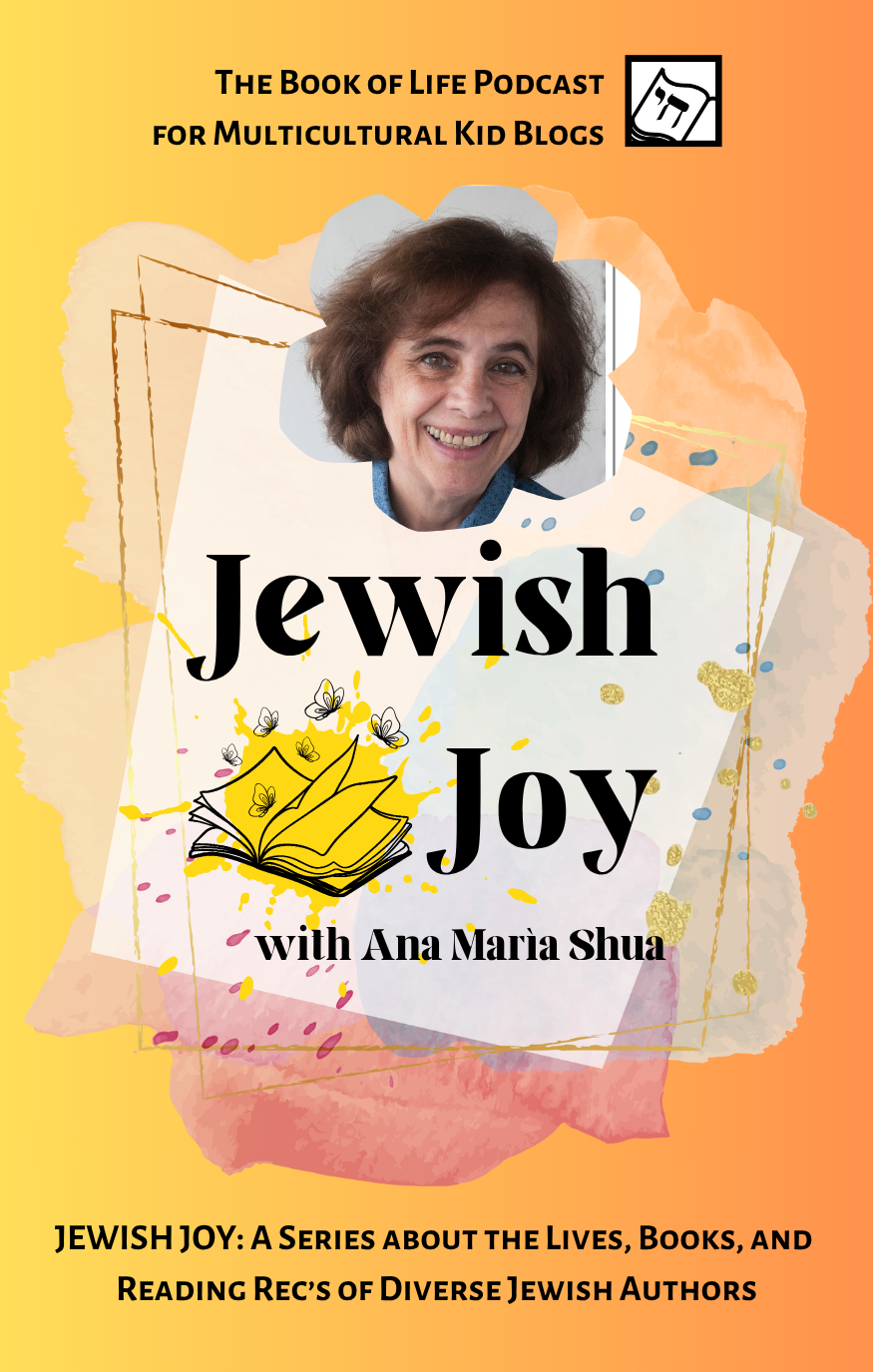
In the last Jewish Joy post in this series, you met Joanne Levy, a Canadian Jewish author who writes heartfelt realistic middle grade fiction. Today, I’m thrilled to introduce you to Ana María Shua, a very prolific Argentine author who recently created her first English-language Jewish children’s book, The Passover Pet Surprise. In Argentina, Ana María is well-known for her flash fiction, poetry, novels, drama, film scripts, and other Jewish and secular works for adults and children. She appeared on The Book of Life Podcast in March, 2026.
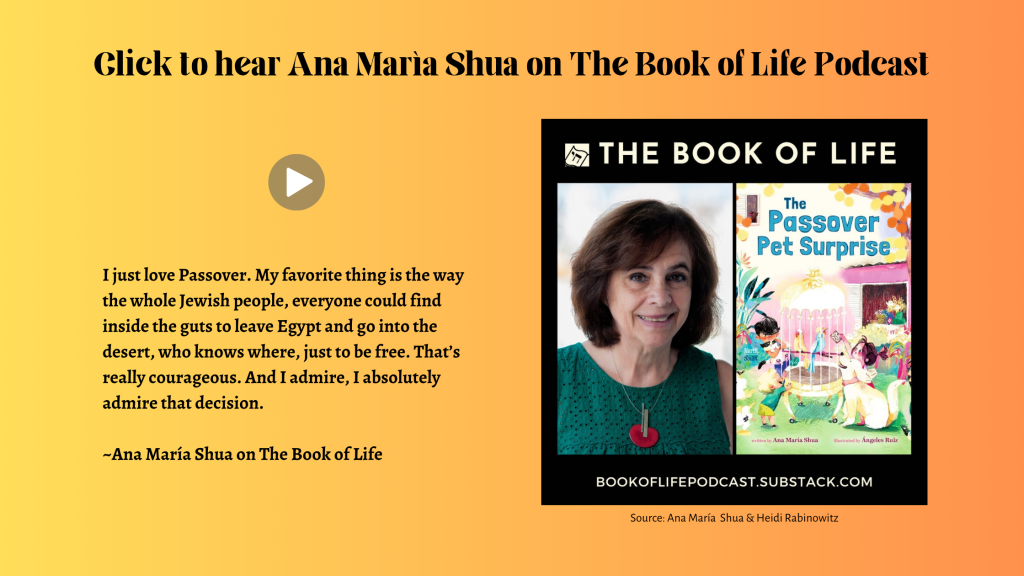
Ana María’s book, The Passover Pet Surprise, is also available in Spanish as La gran sorpresa de Pésaj. It explores themes of of right and wrong, of freedom, and of family togetherness. I’m pleased to bring you this exclusive Jewish Joy interview for Multicultural Kid Blogs, and if you’d like to hear more from Ana María in her own voice, please click on the podcast link below.
Q&A with Ana María Shua
THE BOOK OF LIFE: Ana María, please describe your own Jewish identity, along with any other aspects of your identity that you’d like to share.
ANA MARÍA SHUA: I am a half-and-half Jewish woman: half Ashkenazi, half Sephardic. I was born in Buenos Aires, Argentina. My grandfather on my father’s side came to Argentina from Beirut, Lebanon. My grandmother Ana Levy, whose name I bear, belonged to the Moroccan community. My real last name is Schoua; I chose Shua for my
books because this is how it should be pronounced.
On my mother’s side, my grandparents came from Poland. My mother’s last name is Szmulewicz. My grandfather came to Argentina while his six siblings went to the
USA, so today I have a very big Ashkenazi family all over America. It took me many years to understand that both my grandfather Musa and my grandfather Meishe had the same name, and that it was Moses, just like Charlton Heston in The Ten Commandments, probably the only Jewish education I had when I was little.
My parents were atheists, both of them; not even my grandparents Szmulewicz were believers. But my father was a militant atheist, against his own Schoua family, and he was afraid that any kind of Jewish education could drag me and my sister into religion. Of course, all their friends were Jews, we were members of two Jewish clubs, and everything and everyone around my family was Jewish…
I went to public schools, public high school, and public university, and I never felt discriminated against because of being Jewish. Argentina has a very open society.
Of course, we do have antisemitism, just as in any other country in the world, but it is not the dominant note. We are the largest Spanish-speaking Jewish community
in the world, and we are very integrated into Argentine society.
I sent my own girls to public schools too. But today, two of my granddaughters go to a Jewish school, and their mother, my daughter Gaby, works at AMIA (Mutual Jewish-Argentine Association).
TBOL: Why is it important to you to include Jewish representation in your writing?
AMS: I write short stories, flash fiction, children’s books, and novels. I don’t include Jewish representation in everything I write, but when I do, it is simply because I
cannot help it. You write with everything you are. I am Argentinean, Latin American, I am a woman, and I am Jewish. It is part of myself, part of my personality; it’s in my soul, in my heart, in my mind, and in the tip of my fingers whenever they touch the computer keyboard.
When I am writing a novel, for instance, it is impossible for me to imagine a main character who is not Jewish. Maybe it is not always evident for readers, but it is
always there for me.
I discovered and read a lot about Jewish history when I was already an adult, and I was fascinated by its richness and its importance in our contemporary world. I read the Torah by myself and then the whole Tanach, seduced by the amazing amount of poetry, wisdom, and wonderful narrative skills. No wonder the Biblical stories have crossed time and continents and nations and are still strong and alive.
How could I dismiss the importance of my feelings toward my Jewishness in everything I write, even when it is not obvious?
TBOL: About being Jewish: what is hard, and what brings you joy?
AMS: I am so proud of being Jewish. We are a great small nation. Only about fifteen million in the whole world, and even so, always in the first place as artists, musicians, scientists, writers, philosophers—just to begin with.
We are no worse and no better than any other people in the world, but we have
always placed intellectual achievements in the first place; that’s part of our
tradition and heritage. Even centuries ago, it didn’t matter how poor a Jewish family was: their children had to learn how to read and write. A Jew could not be illiterate; being able to read the Torah was a must. It defined us.
Our greatest Argentine writer, Jorge Luis Borges, called us “the nation whose homeland is a book.” Of course, that was before the State of Israel was founded. My homeland today is Argentina, and I deeply love my country. But I know that I could be an Israeli citizen if I needed to, and our sad history reminds us how important it is for Jews to have a land of our own, no matter how Argentine, American, or German we feel.
And what is hard? This is more difficult for me to find and explain. I don’t feel it is hard to be a Jew. What I hate most today is the feeling that any and every Jew in the world is considered responsible for all of the Israeli government’s decisions, whether we agree with them or not.
I defend the existence of the State of Israel in every possible way, but I don’t always agree with its government, and that is very difficult to explain and have accepted by non-Jews.
TBOL: What do you want the world to know about Jewish people?
AMS: I want the world to know how very different we are from each other. There are lots of Jewish jokes about our constant disagreements—you know, two Jews, three
opinions, and so on—but sometimes I feel the world imagines we are all the same, that we all think the same. And that is a form of antisemitism, of course.
I would like the world to understand that we can be absolutely integrated into the country where we were born, like the USA or Argentina or any other country in the
world. And even so, we are still Jews and belong to the Jewish people, and this is not something we can choose.
Our children will be Jews, whether they want it or not, and the children of our children. This is not something we decide; this is something that just happens to us, so it is better to accept it, enjoy it, and transmit it to the next generation.
And we can be loyal to our homeland and loyal to our Jewish heritage at the same time, and there is no contradiction.
TBOL: Tell us about any Jewish books you’ve written.
AMS: As I already told you, my Jewishness can be found everywhere in my writing. But I have written some specifically Jewish books.
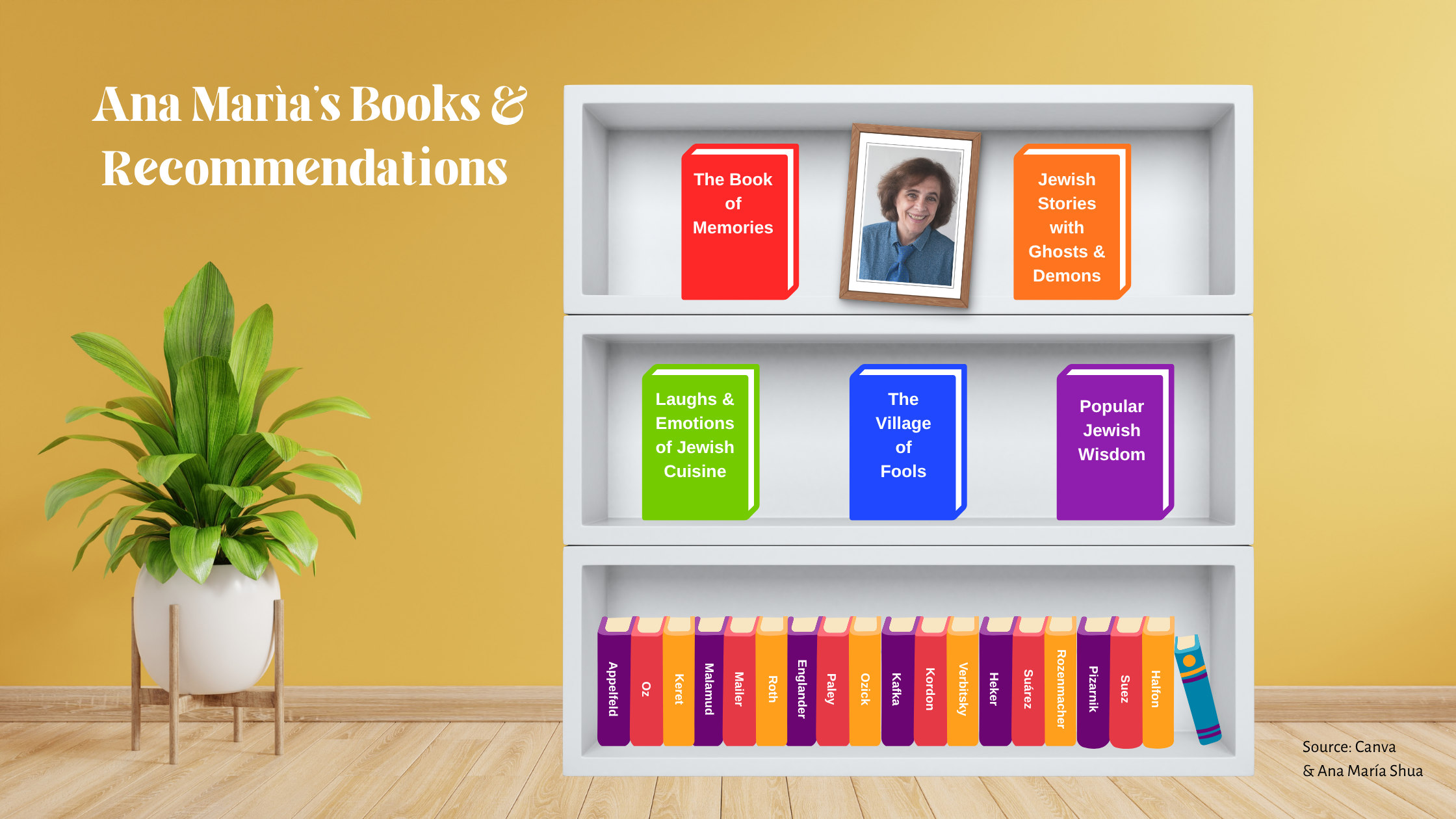
I wrote The Book of Memories, a novel about a Jewish family in Argentina which—in spite of its name—is not a memoir; it is not autobiographical but a work of fiction.
Then I published Jewish Stories with Ghosts and Demons, retelling old Jewish folklore stories and some of my own, based on ancient Jewish folk beliefs, like “A Dybbuk in America.” It was meant for older children and teenagers. After each story, I include a short explanation about where and how the original story was born.
Then came Laughs and Emotions of Jewish Cuisine, a mixture of recipes and humor about what happened to Ashkenazi cuisine in Argentina.
I wrote what I believe is the only book in Spanish about the Wise Men of Chelm, which I titled The Village of Fools, and a collection of Jewish phrases and paragraphs taken from many different anonymous Jewish books, from the Bible to Yiddish proverbs, called Popular Jewish Wisdom.
TBOL: What other Jewish books are you excited about, and why?
AMS: So many, Heidi! How can I choose?
The wonderful thing about writers and books is that you don’t have to choose which one is better or more important. It is not like a tennis championship, where the best one wins over all the others. Each writer has his or her own way of seeing the world and telling us about it.
Absolutely at random, I can mention Israeli authors like Appelfeld and the amazing originality of what he did with his experience in World War II, or Amos Oz, with his
sensitivity and intelligence, or that crazy genius who reinvented the short story, Etgar Keret.
Hundreds of Jewish American authors—Malamud, Mailer, Roth—you know, all the classic Jewish American marvels, and a little younger, Nathan Englander, among so many others I absolutely admire.
And the women, of course: Grace Paley, Cynthia Ozick… Oh my, I am excited about so many great Jewish authors all around the world. Kafka in the first place.
Lots of them in Argentina, of course: Bernardo Kordon, Bernardo Verbitsky, Liliana Heker, Patricia Suárez (Cohen is her mother’s name), Germán Rozenmacher, Alejandra Pizarnik, Perla Suez…
The great Guatemalan author Eduardo Halfon…
And why? Well, just because they are great writers. They understand and love and produce the best literature in all its ambiguity, its constant questions, its lack of simple answers, its ability to unsettle readers and make them uncomfortable, its power to question reality and reveal it in all its madness and absurdity.
Just like any other great writers of all nations—except that I am a little bit more proud if they are Jewish.
TBOL: Ana María, thank you for your enthusiasm and your wonderful writing!


Heidi Rabinowitz
Latest posts by Heidi Rabinowitz (see all)
- Jewish Joy with Rachelle Burk - August 24, 2026
- Jewish Joy with Adam Gidwitz - July 13, 2026
- Jewish Joy with A.R. Vishny - June 15, 2026
