I’m Heidi Rabinowitz and I am so happy to be Jewish. The beautiful and varied customs, the focus on deep thought and learning, and the historical connections going back over the centuries, all bring me joy. That’s why I’ve dedicated my career to synagogue librarianship and why I’ve been podcasting about Jewish children’s literature for over a decade. That is also why I created the Jewish Joy series. In fact, the 20th anniversary of The Book of Life Podcast will take place in December 2025 – stay tuned, I’m making celebratory plans!
What?
I’m thrilled to share this Jewish Joy series for Multicultural Kid Blogs with you. I’ll be bringing you Q&A’s from diverse intersectional Jewish authors, showcasing the variegated tapestry of Jewish life and books. In each interview, I’ll link back to the author’s appearance on The Book of Life Podcast for you to hear their voice and learn more about them.
Why?
In these turbulent times with antisemitism at record highs, Jewish Joy is crucial. As poet Toi Derricotte says, joy is an act of resistance. Joyful books invite everyone in, so that Jewish stories can, in the words of Dr. Rudine Sims Bishop, become windows as well as mirrors, bringing hope, demystifying the Jewish experience, and building empathy and understanding.
Who?
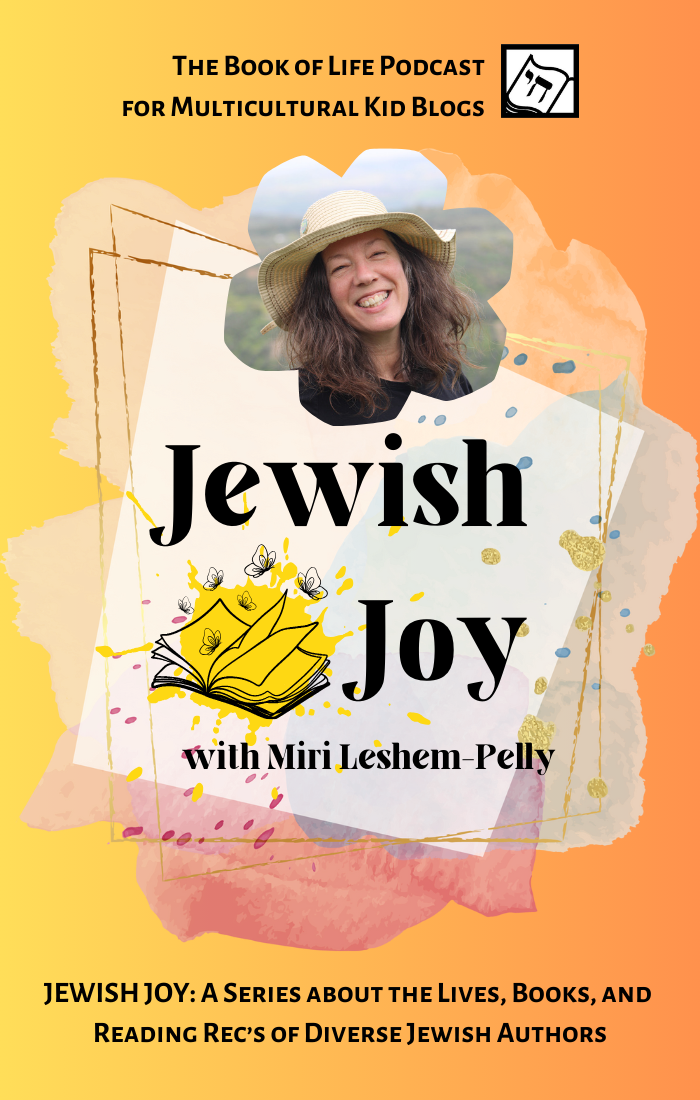
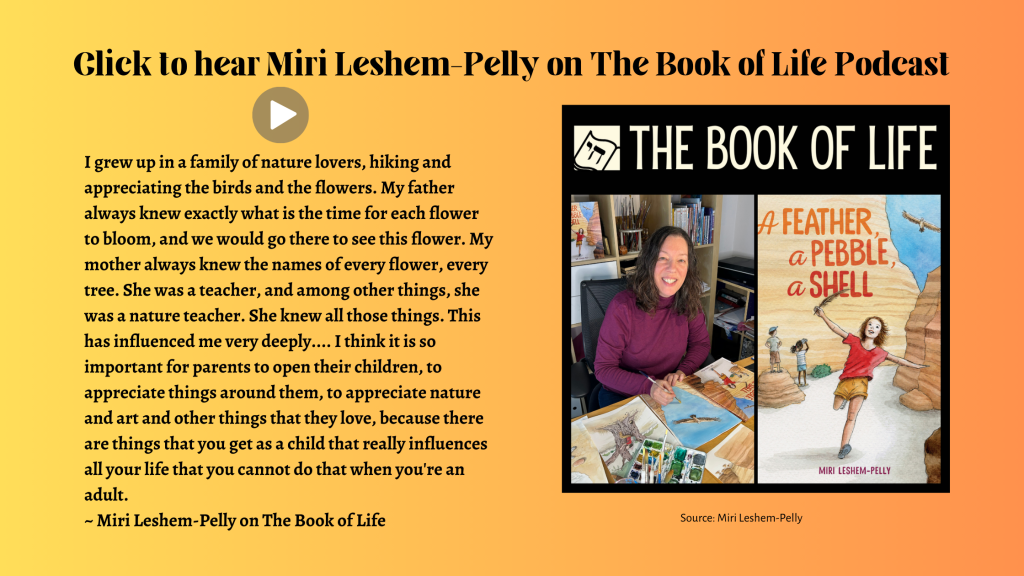
In the last Jewish Joy post in this series, you met Modern Orthodox author Josh Levy. Today, I’m thrilled to introduce you to Miri Leshem-Pelly, an Israeli author and illustrator of 17 books, some in Hebrew and some in English. She combines her love of nature and her love of art in her work, especially in her recent English-language picture book, A Feather, a Pebble, a Shell, which she spoke about on The Book of Life podcast in April 2025.
Miri’s writing is poetic and her illustration style, fascinatingly, changes depending on the requirements of each book. I’m pleased to bring you this exclusive Jewish Joy interview for Multicultural Kid Blogs, and if you’d like to hear more from Miri in her own voice, please click on the podcast link below.
Q&A with Miri Leshem-Pelly
THE BOOK OF LIFE: Miri, please describe your own Jewish identity, along with any other aspects of your identity that you’d like to share.
MIRI LESHEM-PELLY: I was born Jewish in Israel, to Jewish parents who were also born in Israel. All of my grandparents immigrated from Europe in the 1920s, before World War II, and each of them lost almost their entire family in the Holocaust. Both of my parents were born and raised in Tel Aviv, and they always shared with me their childhood memories growing up under British Mandate rule, about the fulfillment of the dream when the State of Israel was established, and how they danced in
the streets with the crowds on that joyful day. Both of my parents also served in the army—my father was a combat soldier; he fought in the Six-Day War and in the Yom Kippur War.
I think that, having been born and raised into this reality, it never seemed like something special to me—just something natural that I was a part of: being Jewish and Israeli, like everyone else around me.
TBOL: Why is it important to you to include Jewish representation in your writing?
MLP: As I mentioned earlier, my identity as a Jew and an Israeli is simply something natural and self-evident to me. At the same time, I’ve always been aware of the problem of antisemitism. In Israel, we learn from a very young age about the Holocaust and about hatred toward Jews. When I was 10 years old, I traveled abroad for the first time in my life. We went on a family trip—my mom, dad, my older brother, and I—for a whole month in a caravan, traveling through various countries in Europe. I have wonderful and moving memories from that trip, but there were also unforgettable, sad, and difficult moments—like when we visited concentration camps in Germany and the house where Anne Frank hid in Amsterdam.
Throughout my life, I’ve always carried in the background this fear that antisemitism will rise again in a big way, and that Jews will once again face an existential threat. Alongside that fear is also the joy that we have Israel—a land for the Jews. That we have our own army, that we’re no longer in the same situation we were in during the Holocaust, that we can defend ourselves, and that Jews who find themselves in danger around the world will have somewhere to escape to. That’s why it’s important to me to represent Israel and to make my voice heard as an Israeli in the world.
TBOL: About being Jewish: what is hard, and what brings you joy?
MLP: One of the things that’s difficult for me as a Jew is the issue of gender. I’m secular, and that’s how I was raised from childhood, but my family has always had a connection to Jewish culture and tradition, and we celebrated the Jewish holidays. Every time I enter a synagogue where there is separation between men and women, I feel uncomfortable. I don’t like the fact that the women are placed in a distant area and have to be hidden. In Israel, there are hardly any Reform synagogues, and this separation—which reflects gender inequality—has always bothered me.
Things that bring me joy in Judaism: being with the whole family on Passover night, celebrating Hanukkah with songs and latkes, and the holiday I loved most as a child was Purim. What a fun, colorful, creative, and funny holiday! Dressing up as whatever I wanted, giving freedom to my creativity when I made my costume, and seeing everyone else’s costumes—it is such a joyful time.
TBOL: What do you want the world to know about Jewish people?
MLP: It’s important to me that people understand we are not just a religion. We are a people, a culture. I’m always fascinated by the diversity that exists within the Jewish world—so many different cultures that came from different places all over the world, and at the same time, there are many things we share. Customs and holidays that we all celebrate, and of course the Bible—the remarkable book that connects our people.
It’s amazing to think about this small and ancient nation that has managed to survive for so long and through so many threats and challenges. I’m also amazed by the Hebrew language, one of the oldest languages in the world, and I feel honored that this is my language.
TBOL: Tell us about any Jewish books you’ve written.
MLP: I haven’t written books about Judaism, but rather about Israel. My favorite subject is nature. Since I grew up in Israel in a family that loves nature and hiking, the local nature of Israel is truly a part of me. Most of the books I’ve written and illustrated so far are about nature in Israel. Some of them I wrote in Hebrew and they were published in Israel, and there are two books about nature in Israel that I wrote in English and were published in the United States.
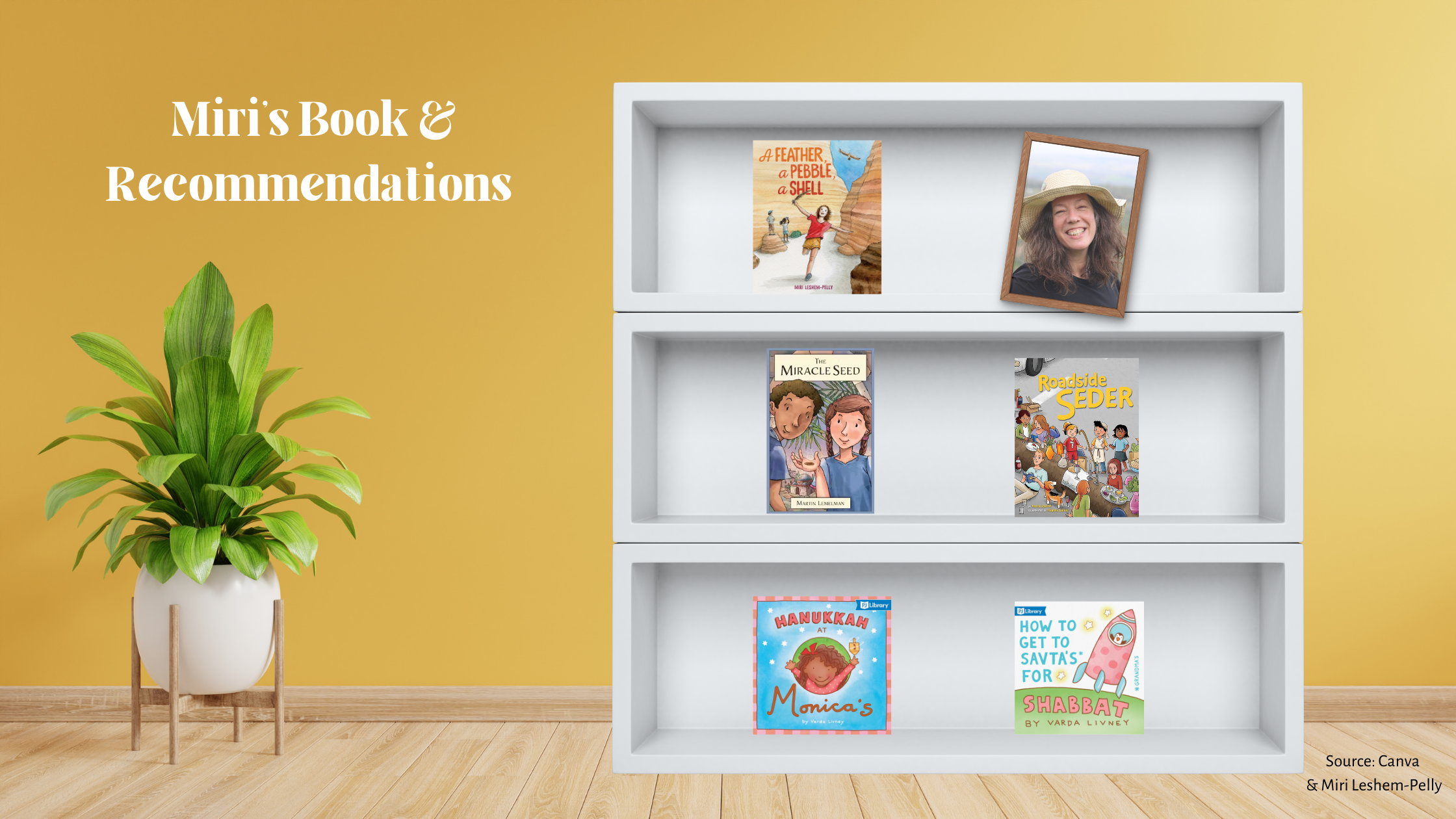
My new book, A Feather, A Pebble, A Shell, was published by Kar-Ben and also released as part of the PJ Library program. The protagonist of the book is an Israeli girl who tells, in first person, about her experiences exploring interesting natural sites throughout Israel. Through this book, I hope to connect children in the U.S.—especially Jewish children—to get to know and love the beautiful and unique land of Israel, and maybe the book will inspire them to come and explore it for themselves.
TBOL: What other Jewish books are you excited about, and why?
MLP: I really love the book by Martin Lemelman, The Miracle Seed. It’s a fascinating graphic novel based on a true story. The book wonderfully conveys a story that is both scientific and magical. It has a journey back in time into history, alongside modern-day innovation and technology, and it features inspiring, real-life characters—Israeli women scientists who succeeded in bringing back to life an ancient plant that had become extinct.
I was also very excited about the new book Roadside Seder, written by Anna Levine and illustrated by Naama Lahav. The story takes place in Israel and describes a situation in which a date palm tree falls and blocks the road on Passover night, when many families are traveling to celebrate with relatives. With no other choice, everyone gets out of their cars and ends up celebrating a Seder together in the middle of the road. Each family brings its own traditional foods and customs,
creating a cultural encounter that beautifully illustrates the rich diversity that exists in Israel.
And I also really love the Jewish themed board books created by Varda Livney, for example, Hanukkah at Monica’s and How to get to Savta’s for Shabbat. Varda is in my critique group with other author-illustrators, and she never ceases to amaze me with her creativity and her deep understanding of toddlers. Some people think it’s easy to write and illustrate for toddlers—but it’s really not! Varda knows how to create stories that are engaging, joyful, full of imagination and fun, that also empower little ones and offer learning—and she does it in a way that toddlers can understand, relate to, and enjoy. Being able to achieve all that with such short text and minimalist illustrations is an exceptional talent that very few people have.
TBOL: Miri, thank you for your creativity and for bringing us a taste of Israel and a glimpse of Jewish Joy!


Heidi Rabinowitz
Latest posts by Heidi Rabinowitz (see all)
- Jewish Joy with Deke Moulton - October 19, 2026
- Jewish Joy with Richard Michelson - September 22, 2026
- Jewish Joy with Rachelle Burk - August 24, 2026

I enjoyed Miri’s interview here as well as on The Book of Life podcast. Thank you for sharing your Jewish joy!
Thank you for this beautiful interview, Heidi. I appreciated learning about your book journey, Miri. A FEATHER, A PEBBLE, A SHELL is a wonderful reflection of Jewish joy.