For the last five years, studies focused on tweens and teens reflect consistent growth in struggles with anxiety for young people. Many of the studies focus on the United States, but some global studies indicate that this is a worldwide trend. Possible reasons vary: social media use, climate change, COVID-19, gun violence, etc. The list goes on and on. We may also all be feeling a little more anxious than usual at this time of year. Thus, I wanted to share my experience of managing anxiety and the tools and books that are working for my family.
As a parent with anxiety who is raising two teenagers, one who shares my anxious struggles, I’ve learned that viewing anxiety as good or bad is not helpful. Further, I’ve discovered that worry does not indicate that something is “wrong” with us or our children. Our children are gaining increasing awareness about the world around them and, the challenges facing the world, and anxiety can follow. In fact, it may indeed be an appropriate response. Thus, providing our children (and ourselves) with tools to manage anxiety matters. This may be appointments with a trained professional (a therapist, a psychologist, a psychiatrist). But having tools on hand that can be used at home, in school, in the car, or any place where anxiety may strike, can be incredibly helpful.
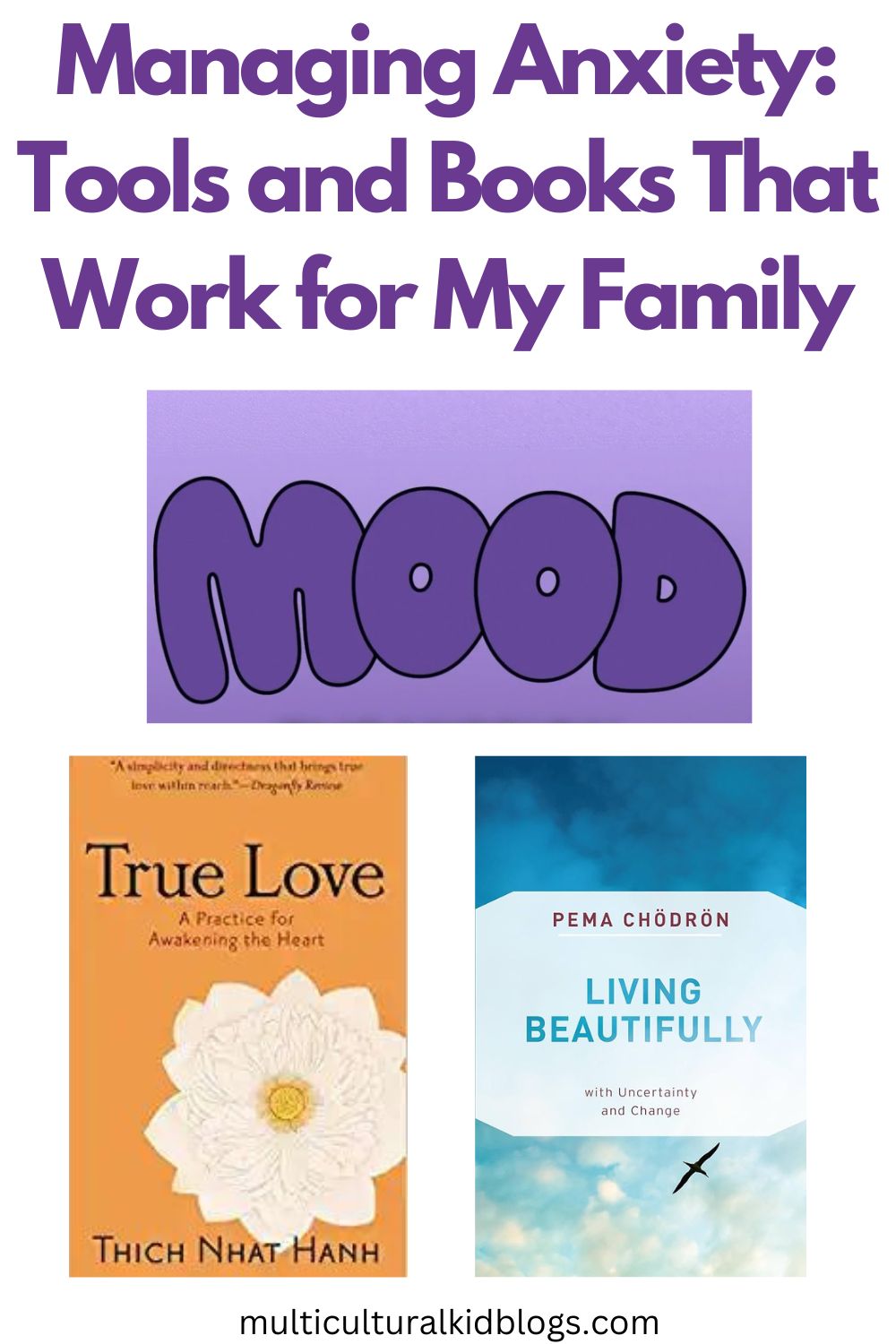
Mood Tools for Managing Anxiety
Personally, I’ve benefited a great deal from a meditation practice. However, meditation is something that has never connected to my anxious one. Recently, I introduced them to some of the tools shared by Mood, and they found those tools quite helpful. Thus, I wanted to share our favorite Mood Tools:
- Butterfly tapping. This exercise helps individuals ground themselves.
- “Calm down with color” is another Mood Tool that students really appreciate.
- Categories is a technique I use when I am having trouble falling asleep at night.
- The Back to Nature tool reminds us of the power of our natural environment to ground us and bring us back to the center.
While the videos on the site are engaging and helpful, I appreciate that these tools can be used at any place and anytime, with or without the video on hand once you’ve established a practice with them.
My teen also connected with the Hand Breathing exercise highlighted in Lesson 1 of the Mood Classroom tools. These tools are easy-to-use resources for any learning environment. There are nine short lessons available, each highlighting a different calming technique.
Books to Support Meditation and Mindfulness
Being Peace by Thich Nhat Hanh
When I first read Being Peace, I struggled with “the big question.” What should I do with my life? I was working to untangle “purpose.” Now, as a parent, I still find this book to resonate with me. I see how my ability to be at peace affects my children. If I can focus daily on peace, I will model this for my children.
True Love: A Practice for Awakening the Heart by Thich Nhat Hanh
This book, particularly, helped me on my journey toward fully loving and accepting myself. This includes the traits we are not proud of. Thich Nhat Hanh uses beautiful analogies to foster healing and wholeness in our hearts. He speaks about treating one’s negative feelings with love. Instead of burying or pushing them aside, we should pick up our jealousy/anger/resentment. We can hold it, recognize it, then release it. Anxiety is the same. Learning to hold it, recognize it, and then release it can be incredibly freeing.
When Things Fall Apart by Pema Chödrön
The book focuses on difficult times and the healing (and grieving) process they demand. As a parent, this book reminds me to honor my need and my child’s need to feel things, even the painful things. Often, we want to shield our children from pain, but this is impossible. Instead, our role is to help them navigate their feelings. This can mean getting them professional support when they need it. As a parent, I sometimes feel like I’m falling apart or grieving for a world that confounds me. This book taught me to see these as opportunities to wake up and engage.
Living Beautifully with Uncertainty and Change by Pema Chödrön
This book taught me the power of 90 seconds. Chödrön stresses that the physiological cycle of our anxiety is 90 seconds, but it often lasts much longer. We feed the anxious mind, piling more worry onto our existing worries. She suggests stopping and counting to 90. This technique has been incredibly helpful for me.
Banishing anxiety (from our own lives or from our children’s lives) is not realistic. Plus, worry does serve a purpose. Thus, the key lies in identifying tools to manage anxiety so it does not overwhelm us.
What tools are in your toolbox? Please share so that we can learn and grow together as we manage anxiety.
Related Posts
Social-Emotional Learning (SEL) and Why It Matters
Transition: Helping Your Children Through Change
Travel Well: Practice Family Yoga at the Airport

Jennifer Fischer
Latest posts by Jennifer Fischer (see all)
- Hannah Edwards: Secrets of Riverway - January 26, 2025
- Managing Anxiety: Tools and Books That Work for My Family - November 4, 2024
- Representation Matters: Afro-Latino Characters in the Media - October 7, 2024
