I’m Heidi Rabinowitz and I am so happy to be Jewish. The beautiful and varied customs, the focus on deep thought and learning, and the historical connections going back over the centuries, all bring me joy. That’s why I’ve dedicated my career to synagogue librarianship and why I’ve been podcasting about Jewish children’s literature for over a decade. That is also why I created the Jewish Joy series. The 20th anniversary of The Book of Life Podcast took place in December 2025 – listen to the Retrospective Spectacular HERE!
What?
I’m thrilled to share this Jewish Joy series for Multicultural Kid Blogs with you. I’ll be bringing you Q&A’s from diverse intersectional Jewish authors, showcasing the variegated tapestry of Jewish life and books. In each interview, I’ll link back to the author’s appearance on The Book of Life Podcast for you to hear their voice and learn more about them.
Why?
In these turbulent times with antisemitism at record highs, Jewish Joy is crucial. As poet Toi Derricotte says, joy is an act of resistance. Joyful books invite everyone in, so that Jewish stories can, in the words of Dr. Rudine Sims Bishop, become windows as well as mirrors, bringing hope, demystifying the Jewish experience, and building empathy and understanding.
Who?
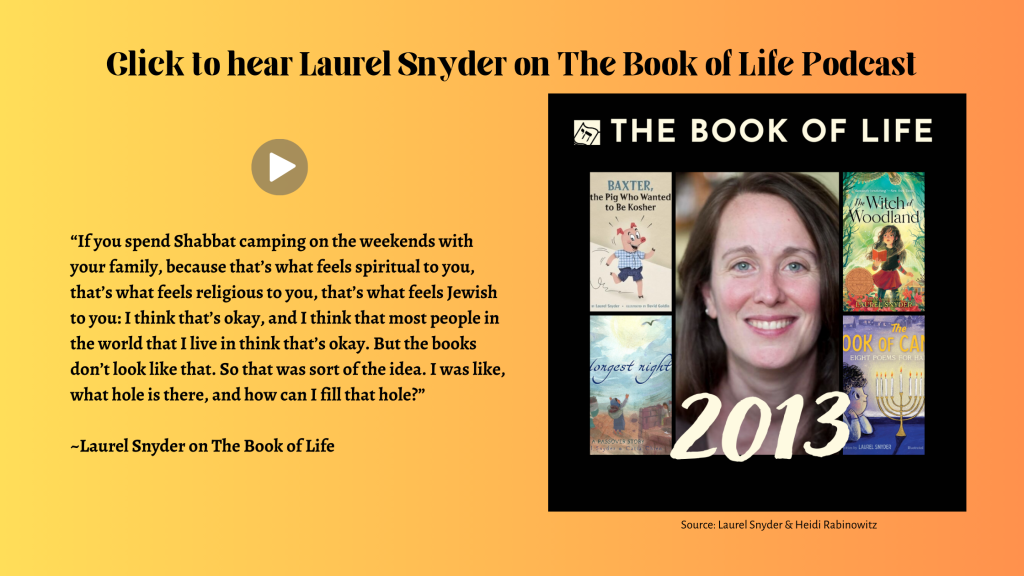
In the last Jewish Joy post in this series, you met Israeli author Miri Leshem-Pelly. Today, I’m thrilled to introduce you to Laurel Snyder, whose Jewish writing journey I’ve been following for nearly two decades. Her early work reflected her ambivalence as an interfaith author writing about Jewish topics, while her later work embraces her Jewish heritage fully. During the podcast’s anniversary year, I brought back many archival episodes from the show’s history, including an interview with Laurel that first appeared on The Book of Life in November 2013.
Laurel’s writing is iconoclastic yet sensitive and deeply thoughtful. I’m pleased to bring you this exclusive Jewish Joy interview for Multicultural Kid Blogs, and if you’d like to hear more from Laurel in her own voice, please click on the podcast link below.
Q&A with Laurel Snyder
THE BOOK OF LIFE: Laurel, please describe your own Jewish identity, along with any other aspects of your identity that you’d like to share.
LAUREL SNYDER: This is so interesting! I’ve been thinking a lot lately about “identity” in general, and “Jewish identity” in particular. I’m in a big moment of transition, and I find myself considering all the ways that identity changes as we grow/age. Twenty years ago, I became a mom, and that altered everything. For years, my Jewish identity was so grounded in parenting, as we chose a synagogue, joined a havurah, navigated Jewish education, camps, etc. Now my kids are leaving home, and I find that’s reframing my sense of self in so many ways, including Jewishly. Am I the same kind of Jew when the kids aren’t here? I’m not so sure…
I’ve always identified as Jewish. But when I was growing up, the fact of my mother’s Catholicism felt like a huge impediment to feeling fully at home in the institutional Jewish community (by which I mean Hebrew School, the JCC, etc). As I became an adult, that changed, because I realized that my Interfaith understanding of the world might actually be a benefit to the Jewish spaces and communities I inhabited. I wrote about this pretty extensively in books for both adults and kids, and went to work for Jewish organizations. As I did, I think i claimed my full identity, and lost my sense of insecurity. I guess I feel like I often function as a sort of bridge in Jewish spaces. And that feels right to me.
I should probably also mention that my father’s Judaism has always been very rooted in politics. He was very active in DSA and other progressive political groups when I was growing up, and I always felt like my identity was grounded in that important Jewish tradition as well. That’s become more complicated in the last two years, but maybe that’s a conversation for another time.
TBOL: Why is it important to you to include Jewish representation in your writing?
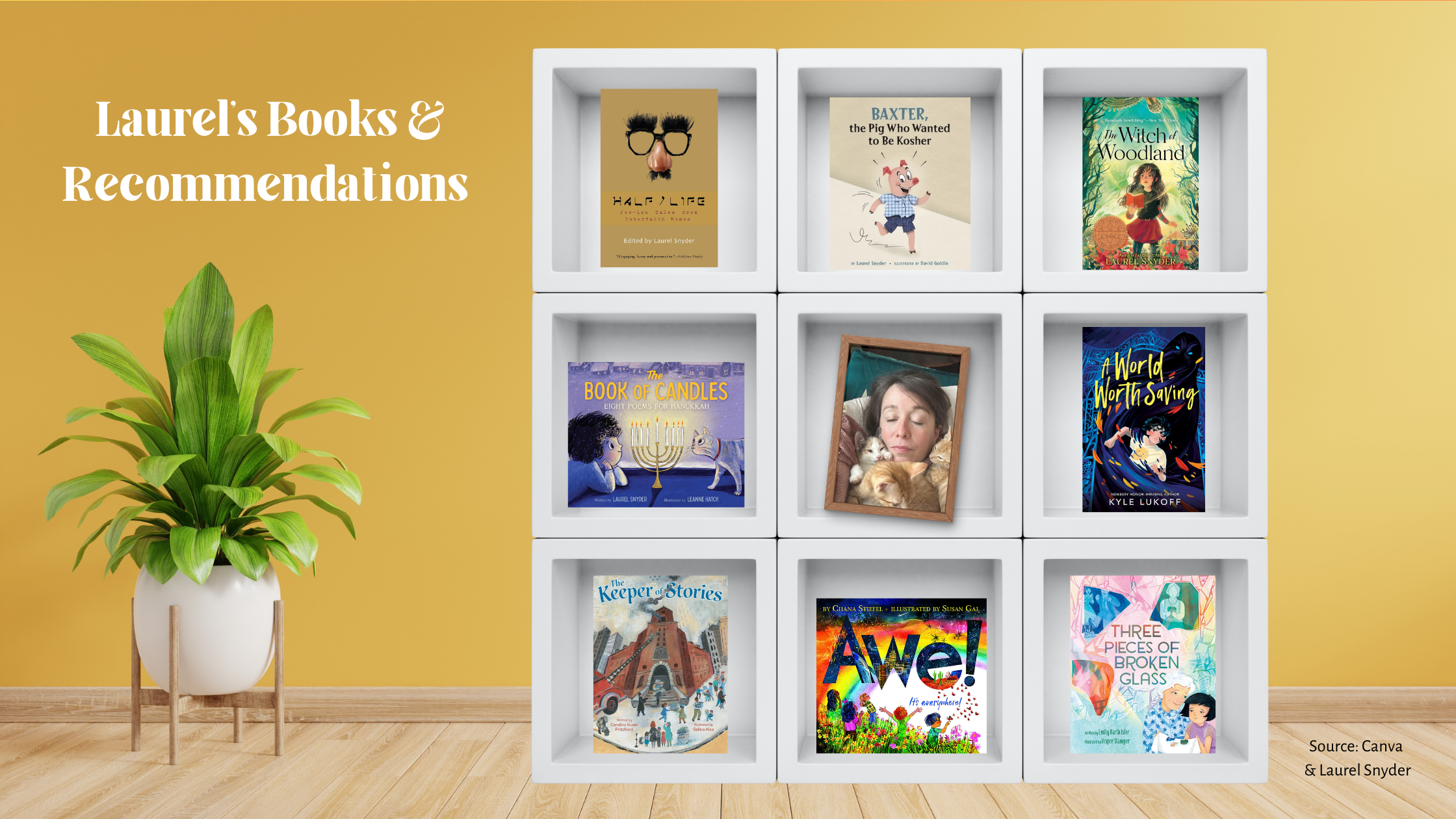
LS: I think that changes with each book! When I started publishing, with books like Half/Life and Baxter, the Pig Who Wanted to Be Kosher, I was consciously trying to make space for Interfaith Jewry, in my own very particular way. I had a definite agenda–to broaden the tent and make space for kids who might feel, as I sometimes did growing up, unwelcome.
When you and I had that important (to me) conversation about Jewish representation, I realized that as a Jewish woman publishing in mainstream secular spaces, I had the power to include Jewish rep in everything I do, whether a book is “about” Judaism or not. And so I did that.
With more recent books, like the Witch of Woodland, I feel like I’ve been able to more fully explore the intersections and intricacies of my own Jewish experience, because the Jewish community has felt more open and inclusive to me. A lot has changed in 20 years, and if you’d told me when I was editing Half/Life that there would someday be space for a character like Zippy (from Witch of Woodland) in middle grade fiction, I wouldn’t have believed you!
But when I published The Book of Candles this fall, I felt like I’d reached a new place with my Jewish writing. I feel like that book integrates so much for me. I wanted it to present a low barrier to entry, and I think it does that. I wanted it to contain meaningful Jewish content that might teach people new things, and I think it does that too. I wanted it to represent my own family, and the way we practice Judaism, but not in a way that might alienate people who are more traditional. Honestly, I’m just so happy with it! It feels complete to me, if that makes sense. The positive response to that book has touched me deeply, because it comes from all corners of the Jewish community. I had a request to visit a Chabad preschool with it, but it also took me back to my own childhood Reform Sunday school for tan event. That feels like magic!
TBOL: About being Jewish: what is hard, and what brings you joy?
LS: Well, the last two years have been hard in so many ways. I see so many rifts and silences, and they’ve been painful. I’m not sure if you want me to go into the details of that here, but as I mentioned, I grew up in both Judaism and progressive politics, and that’s been a hard intersection recently. That said, I take great comfort in the fact that Judaism offers the very tools we need to handle this moment. That, for me, brings joy. The fact that I’m finding partners with whom to have the difficult conversations. People seem to be more ready for that than they were a year ago, and I’m grateful.
You know what else brings me joy? The diversity of Jewish children’s books we have today! When I read a book like A World Worth Saving or The Keeper of Stories, I feel so lucky. Our kids have such a wealth of beautiful new books!
And of course, watching my kids head off to college and find their own particular ways to be Jewish, as they become adults. It’s a special thing to check in with my kid on Friday night and discover he can’t talk to me because he’s helping cook Shabbat dinner. That’s a huge joy!
TBOL: What do you want the world to know about Jewish people?
LS: It’s such a cliche at this point, but I want them to know we aren’t a monolith. It’s so hard to be on social media right now because the antisemitism is just outrageous, and LOUD in a way I’ve never seen before. But antisemitism is built on misunderstandings and stereotypes. People don’t actually hate Jews. They hate the idea they have of us. I feel like Jewish books are actually the best antidote to this–thoughtful, complex, nuanced books that reveal the fullness and diversity of who we are. You can’t hate an entire group of people if you admit that they’re all different from one another. You know what I mean?
TBOL: Tell us about any Jewish books you’ve written.
LS: Ha! I feel like I’ve already name-dropped too many.
TBOL: What other Jewish books are you excited about, and why?
LS: I’ve already named a few of those too, but I’ll say that I’m super excited to get my hands on a copy of Chana Stiefel and Susan Gal’s AWE! Also, Emily Barth Isler and Vesper Stamper’s Three Pieces of Broken Glass.
TBOL: Laurel, thank you for sharing your unique perspective in your writing and in this interview, and for sharing just a few of the many Jewish books you’ve written!


Heidi Rabinowitz
Latest posts by Heidi Rabinowitz (see all)
- Jewish Joy with Deke Moulton - October 19, 2026
- Jewish Joy with Richard Michelson - September 22, 2026
- Jewish Joy with Rachelle Burk - August 24, 2026
