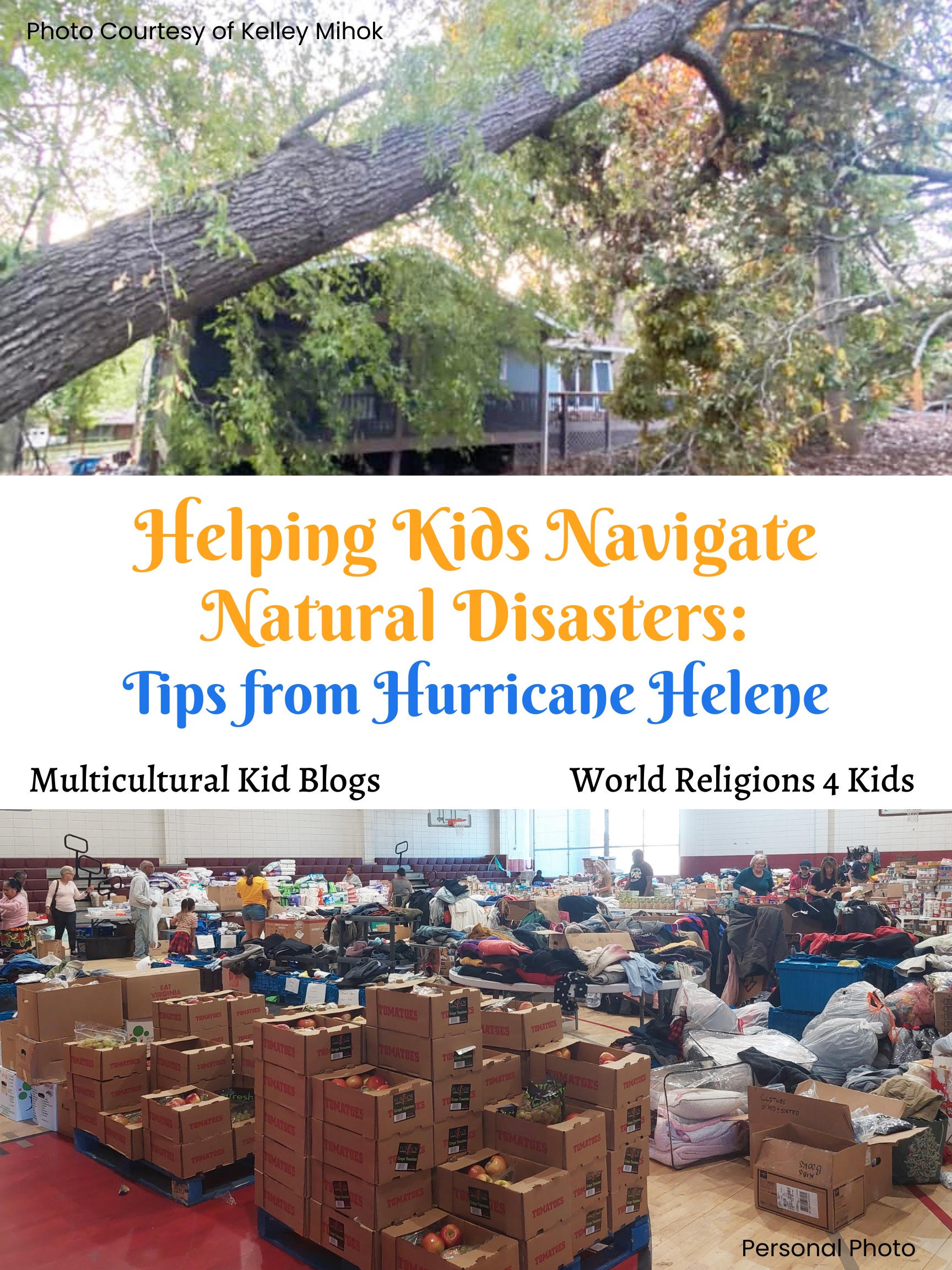
I live in Asheville, NC. Yeah… that Asheville. The tourist town in the Blue Ridge mountains was devastated by Hurricane Helene at the end of September. In my neighborhood, thanks to the ravaging floodwaters, the final toll is 21 houses swept away. A cataclysmic event like this one is difficult enough for adults to process. Imagine what it’s like for our kids.
Despite the challenges, there ARE ways to help children navigate the complexities. In fact, it’s our responsibility, as intentional caregivers, to do just that. As you’ll see, I strongly believe in honesty and balance—an approach that we can adapt to many of life’s inevitable hardships.
Trigger Warning: This post includes photos from the region that could be distressing. It does not include any hurricane-related images of people.
Different Children Have Different Needs

Although obvious, it’s worth reminding ourselves that a one-size-fits-all strategy will never work. Even for my young adult offspring, it still holds true. Immediately after, my daughter focused almost entirely on people. She was on Facebook daily (NOT her platform of choice), trying to connect with friends and their families. She wanted to talk on the phone regularly about who we had heard from and who was still missing.
My son was on TikTok watching raging water videos. When his best friend returned home from a nearby college, my son asked him to stop by and check on us (even though we had told him we were OK). In general, however, he was much more focused on infrastructure – houses, restaurants, roads, etc. – especially for places near our home or places he had frequented as a child.
You know your children best, but achieving nuance becomes complicated when you struggle too. Keep in mind what you already know…each child will probably have a different set of reactions and a different set of needs.
Look for the Helpers during Hurricane Helene
“When I was a boy and I would see scary things in the news, my mother would tell me, “Look for the helpers. You will always find people who are helping.” Fred Rogers
When the hurricane hit on Friday morning, Sept. 27, a tree immediately fell across the road that leads in and out of my neighborhood, pulling down electrical wires, internet cables, and an entire streetlight. My husband looked at the situation and said, “Sorry…. the last time I cut down a tree near our house, I took out the corner of our chimney. Someone else will have to handle this one.” At that moment, however, it was really unclear who that “someone else” might be.
Later that afternoon, a team of about eight men arrived on the scene with big pickup trucks, big chainsaws, and lots of nerve. It wasn’t easy, but they created a plan, moved all the downed wires and cables without actually touching them, and opened our road.

Remind your child that there are always helpers no matter how difficult a situation. Sometimes, they come in the form of the Red Cross, FEMA, and first responders. Sometimes, they come in the form of strangers with chainsaws.
Offer an Honest Assessment of the Situation

It’s not really fair to tell kids, “Everything’s fine,” because, in many ways, it’s not. And they know that. One of my neighbors floated down the river with his dog on the roof of his home and died. I had just seen him a few weeks earlier at a house concert when he showed us the new stained-glass window in his bathroom. Because Asheville is a relatively small town and we’ve lived here for over 25 years, I’m also one degree of separation from 11 other people who died and two degrees of separation from another 12 people who died. Some of those people were children.
There is no free pass in life. Challenging, upsetting things will happen, and the key to living successfully is figuring out how to meet those challenges. Our home was without running water for 17 days, without power for 19 days, and without drinkable running water for 7½ weeks. Some people had it better, and some people had it worse, but it was a horrible situation for the entire region.
There’s no need to sugarcoat the present circumstances. However, there’s also no reason to dwell on the details. Sometimes, life is not OK, but families, friends, and communities get through those times by coming together, leaning on one another, and holding space for grief. We can all do amazingly hard things when we have to. Kids included.
Identify Reasons for Hope
Even though our situation was quite dire, there were regular moments of hope. Neighbors with generators offered outlets for charging phones and shelves in their refrigerators. Neighbors without generators held community cookouts and grilled all the meat about to spoil in their freezer. People shared what news they had – where we might buy gas (nowhere at first), which restaurants were giving away food (since their food was rotting, too), and possible water sources for flushing toilets. When we lost our internet services, cutting off our connection to the outside world, people quickly spread the word about finding a signal at the local Verizon store or on the highway where satellite services were available.
The outpouring of love and support from around the country also began immediately. We stayed totally cut off for about 48 hours, but trucks poured in once a route into and out of Asheville opened. People made supply runs in their cars, dropped off donations at churches and local nonprofits, and semis from neighboring states delivered water, diapers, food, and clothing.

In a natural disaster like Hurricane Helene, your life literally depends on accessing resources. That means taking what you need when you need to and giving when you can. Consider what you have and need, and include your kids in the conversation. Encourage everyone in the family to think creatively. Their resourcefulness might amaze you.
Check in about Social Media
Social media footage provided an accurate eyewitness account of the hurricane, offering details that traditional media channels couldn’t replicate. This was especially true in the immediate aftermath when we remained isolated by impassable roads and a downed internet.
However, the social media algorithms ensured that the most devastating and shocking videos were also the ones that were the most viewed, the most “liked,” and, therefore, the most seen. It was tough on both my kids, even though they are both Gen Z and quite adept at navigating social media.
My son, who was away for his first year of college, came home a couple of weeks after the hurricane for his fall break. In many ways, it was not fun. We still had no power, no running water, and no internet. Supermarkets were starting to reopen, but there were many empty shelves because the supermarket warehouse had also been hard-hit. All but a handful of restaurants remained closed. Frustration ran high, and nerves frayed.
Nevertheless, my son was able to gain some much-needed perspective. He could see for himself which areas had been utterly devastated and which ones were in much better shape. He could hang out with his friends, check in on his former schools, and support local businesses.
Social media is an ongoing issue for parents, but the doom-scrolling was hard to avoid in this scenario. Remember, kids encounter a lot of disaster-related content that you might not see…unless you ask.
Watch for Ongoing Trauma

Infrastructure issues forced schools to close for weeks. In addition, because of internet outages, we could not use those Zoom education strategies so finely tuned during the pandemic. Believe me, parents felt immense joy when kids finally returned to the classroom.m.
However, the apparent return to normalcy also triggered a new set of issues. Everyone, including kids, had adapted to a life of reading books by candlelight in the evening and toting potable water home in our cars. The stress of starting school when the bathroom sinks and drinking fountains were roped off to keep them from being used increased the stress of “getting back to normal.”
As we all know from past life experiences, anxiety, and grief can creep up when we least expect it. Kids are no different, so we must pay attention even when the immediate threats have seemingly passed.
Find Time to Take of Yourself

The highway exit nearest to my house is still closed in our direction. My husband’s usual route to work takes him through two areas that are completely destroyed, with trees still down, businesses emptied out, and piles of dirt everywhere. The River Arts District, home to hundreds of local artists, is gone. The Biltmore House finally reopened in early November, but several surrounding businesses have literally disappeared. Swannanoa River Road, which passes by our Nature Center and serves as my best route to Home Depot, Lowe’s, and Walmart, is still closed. I suppose it doesn’t really matter since Walmart and Lowe’s are still closed, too.
The reality is that sometimes I wake up sad and tired. It’s just a lot to deal with. And some days are simply not that productive. But we are still here. Thousands of roads have been cleared. Trucks continue to manage debris. Buses are running. Schools have reopened. Many businesses are back to business as usual. Perhaps most importantly, we have learned to simultaneously hold two somewhat disparate emotions – sadness and gratitude – in our hearts.
Ultimately, we do what we can, when we can, how we can. And that may be just about as good as it gets.


Vicki Garlock
Latest posts by Vicki Garlock (see all)
- Helping Kids Navigate Natural Disasters: Lessons from Hurricane Helene - January 20, 2025
- 10 Fun Facts for Kids About Summer Solstice - June 19, 2023
- Five Reasons to Teach Our Kids About the World’s Religions - March 13, 2023
